





AI Agents vs Agentic AI: Clearing Up the Confusion for Global SMBs in 2026
ByDishank Sharma

TLDR An AI agent is a single autonomous system built to handle a specific task: it perceives its environment, decides what to do, and acts, usually with memory and tools attached. Agentic AI is the broader approach, the design philosophy of building systems that pursue goals autonomously, whether that means one agent or many working together. Every agentic AI system is made of agents. Not every agent on its own amounts to a full agentic AI deployment. The distinction matters most once an SMB moves from a single automated task to orchestrating several of them, which is exactly where more SMBs around the world are heading in 2026.An AI agent is a single autonomous system built to handle a specific task: it perceives its environment, decides what to do, and acts, usually with memory and tools attached. Agentic AI is the broader approach, the design philosophy of building systems that pursue goals autonomously, whether that means one agent or many working together. Every agentic AI system is made of agents. Not every agent on its own amounts to a full agentic AI deployment. The distinction matters most once an SMB moves from a single automated task to orchestrating several of them, which is exactly where more SMBs around the world are heading in 2026.
A lot of the confusion for SMB leaders right now isn't generative AI versus agentic AI anymore. ( Most teams have settled that question. The new confusion is more subtle: is the "AI agent" a vendor is proposing the same thing as the "agentic AI" leadership read about? Sometimes yes. Often the two terms are being used to describe different scopes of work, and that gap causes real problems during scoping and budgeting, especially for SMBs running lean teams on tighter budgets.
This guide draws the line clearly, using the same kind of practical examples SMB owners and operators are dealing with this year, wherever they're based.
What Is an AI Agent?
An AI agent is a single software system designed to accomplish a defined task with a degree of independence. It typically has:
A goal or task it's responsible for
- Perception of relevant data or its environment (an inbox, a database, a support queue)
- Decision-making logic, usually powered by an LLM
- Tools it can call to take action (an API, a CRM, an email client)
Memory, at least within the scope of the task it's running
A single AI agent might read incoming support tickets, check order history, and draft a resolution. That is one agent doing one job well, and it's the scope most SMBs start with.
What Is Agentic AI?
Agentic AI is not a specific product. It's the architectural approach: designing AI systems around autonomous pursuit of a goal rather than a single request-response exchange. An agentic AI system can be built from one agent handling an end-to-end process, or from several specialized agents that each own a piece of a larger workflow and coordinate with each other.
That second version, several agents working together under some form of orchestration, is what most people picture when they hear "agentic AI" in 2026. But strictly speaking, agentic AI is the umbrella term. The agent is the building block.
AI Agents vs Agentic AI: The Core Difference
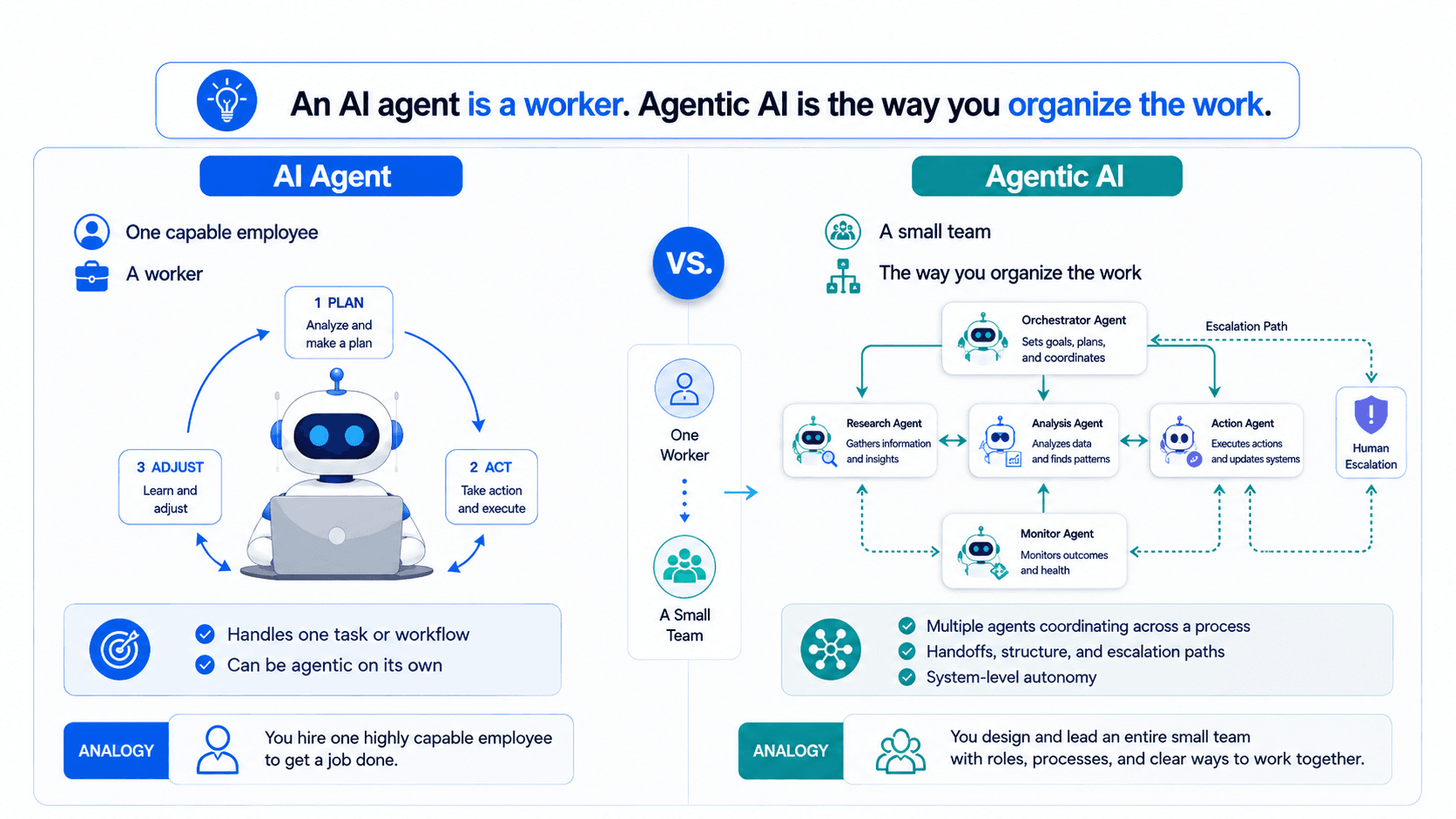
The cleanest way to describe this distinction:
An AI agent is a worker. Agentic AI is the way you organize the work.
One agent can absolutely be "agentic" on its own, if it plans, acts, and adjusts without a human prompting each step. But once an SMB has multiple agents handling different parts of a process and passing work between each other, that's agentic AI operating at a system level, not just a single automated task.
Think of it like the difference between hiring one capable employee and designing an entire small team. The employee is the agent. The team, its structure, handoffs, and escalation paths, is the agentic system. An SMB doesn't need a big headcount to get there, it needs the right structure.
At a glance:
AI Agent, Agentic AI
What it is, A single autonomous system built for one task, The design approach: goal-driven autonomy, built from one or many agents
Scope, One job, start to finish, A coordinated system, possibly spanning several jobs
Example, An agent that drafts support ticket replies, Lead scoring → outreach → CRM logging, run by three coordinated agents
Best fit for SMBs, A well-bounded, high-volume task, A multi-step process currently handled by several people or tools
Single Agent vs Multi-Agent: Where SMBs Actually Get Confused
This is the question that trips up most scoping conversations.
A single agent is the right starting point for a well-bounded task with a clear input and output: monitor an inbox and draft replies, reconcile invoices against a purchase order, screen a resume against a job description.
A multi-agent system is warranted when a process genuinely spans domains that benefit from separate specialization: one agent qualifies a lead, hands it to an agent that drafts personalized outreach, which hands off to an agent that logs everything into the CRM and flags follow-ups. Each agent is simpler and easier to test in isolation. The orchestration layer between them is where the real engineering effort goes.
The mistake we see most often: an SMB asks a vendor for "agentic AI" when what actually solves their problem is one well-scoped agent, and ends up paying for orchestration complexity it doesn't need yet. The reverse mistake also happens, an SMB tries to stretch a single agent across a workflow that really needs task separation, and the agent becomes unreliable because it's holding too much context and too many failure modes at once.
Autonomous vs Semi-Autonomous Agents
Not every agent operates the same way, and this is another distinction worth being precise about.
A fully autonomous agent completes its task and acts, end to end, without a human checkpoint. It's appropriate when the decision rules are clear, the stakes of a mistake are low or easily reversible, and the volume makes manual review impractical, which matters for SMB teams without spare headcount to sit in a review queue.
A semi-autonomous agent plans and drafts, then routes to a human for approval before it acts, particularly for anything customer-facing, financial, or hard to undo. Most SMBs deploying their first agents in regulated or client-facing processes start here deliberately, not because the technology can't go further, but because trust in the system needs to be earned first.
The right choice isn't about how advanced the technology is. It's about how reversible the action is and how well-defined the decision boundary is.
Discrete vs Continuous Agents
There's a third dimension worth knowing: how an agent gets triggered.
A discrete agent runs on a specific trigger, a new invoice arrives, a ticket is filed, and completes its task, then stops until the next trigger. A continuous agent runs an ongoing monitoring loop, watching for a condition (unpaid invoices past a threshold, leads gone quiet for a set number of days) and acting whenever that condition is met, with no single triggering event.
Most SMBs start with discrete agents. They're easier to test, easier to reason about when something goes wrong, and easier to scope in a first pilot. Continuous agents tend to come later, once a discrete agent has proven reliable on a narrower version of the same process.
Real SMB Scenarios
Scenario 1: Single Agent, Fully Autonomous A small finance team gets an agent that pulls vendor invoices from a shared inbox, matches them against purchase orders in their accounting software, and auto-approves anything under a defined threshold with no discrepancy. It escalates the rest. One agent, one job, autonomous within tight rules.
Scenario 2: Single Agent, Semi-Autonomous A two- or three-person support team deploys an agent that drafts responses to incoming tickets using order history and policy documents, but every response sits in a queue for a human to approve before it sends. Same agent architecture, different autonomy level, because the team isn't ready to let it act unsupervised yet.
Scenario 3: Multi-Agent, Agentic System A small sales team runs three agents together: one scores and qualifies inbound leads, a second drafts and sends personalized follow-up sequences based on that score, and a third watches for replies and updates the CRM, flagging anything that needs a rep's attention. No single agent does the whole job. The system does, without adding headcount.
Where SMBs Are Right Now?
Most SMBs we talk to have deployed, or are piloting, single-purpose agents: one process, one agent, a clear before-and-after. Multi-agent orchestration is the conversation happening at the leadership level for 2026 and beyond, and it's a bigger commitment. It requires clean handoff points between agents, monitoring across the whole chain rather than one system, and a clear answer for what happens when one agent in the chain fails or produces something wrong.
The SMBs that will move to multi-agent systems successfully are the ones that got a single agent working reliably first and used that as the proving ground for data quality, monitoring, and escalation design before adding a second and third agent into the mix.
How HabileLabs Helps SMBs With Agentic AI and Agents
We help lean teams figure out which of these they actually need before any building starts. That usually means an honest look at the process: is this one well-defined task, or several distinct tasks that currently get handed off between people? The answer determines whether the right build is a single agent or a coordinated multi-agent system, and it shapes the budget and timeline too.
From there, we scope the first deployment around a specific, high-volume, well-defined process, choose the right autonomy level for that process's stakes, and build the monitoring and escalation layer that lets a small team see what each agent is doing and step in when needed.
We work directly with both AWS Bedrock Agents and Salesforce Agentforce, and can help you understand which platform fits your environment and your path from a single pilot agent to a broader agentic system, sized for an SMB budget.
Connect with the HabileLabs team → to talk through where your process sits.