





Azure vs AWS for Indian SMBs: Which Cloud Actually Fits Your Business in 2026?
ByDishank Sharma

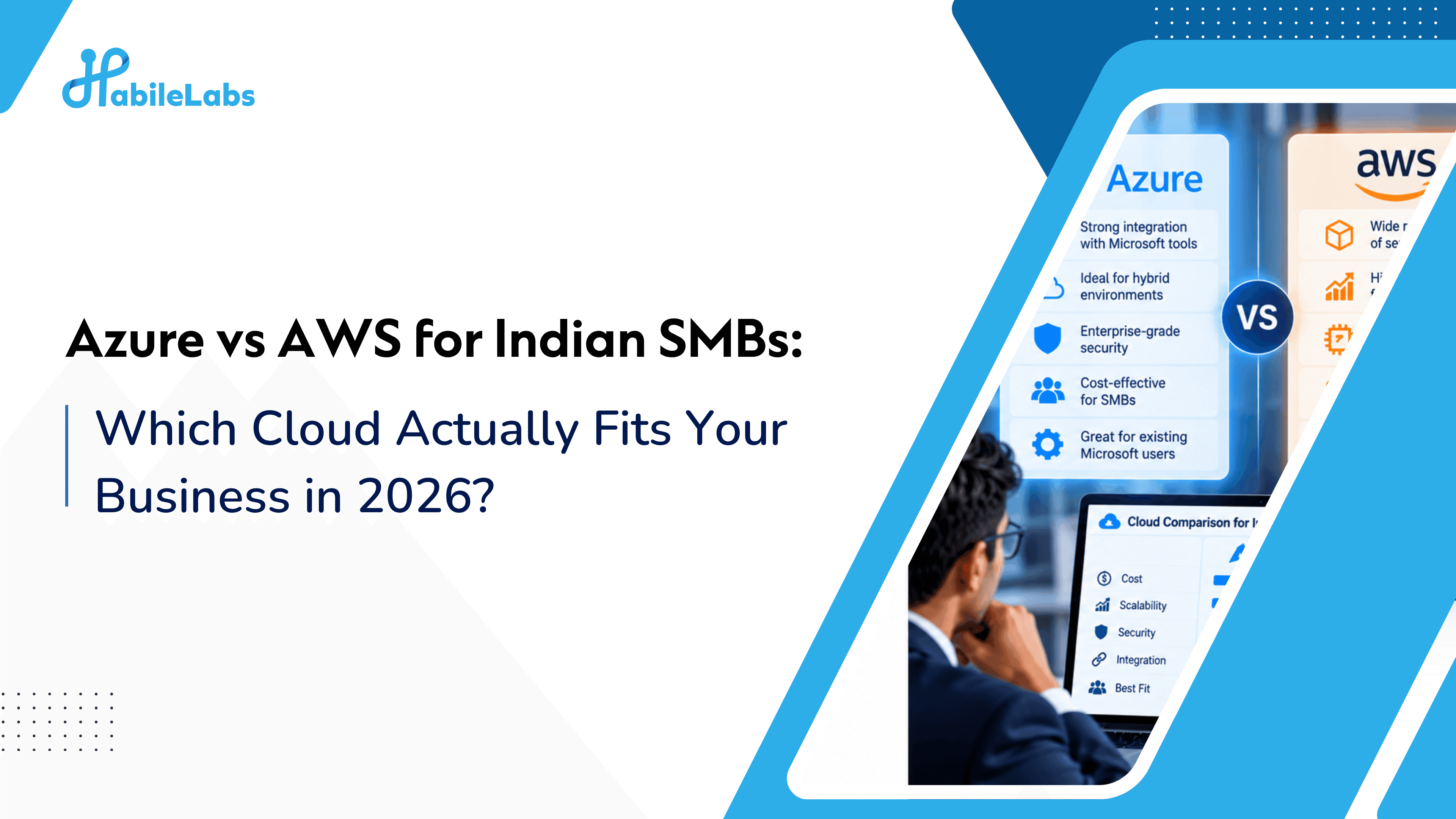
AWS leads globally with 31% cloud market share and the broadest service catalog. Azure is growing faster at 30% year-over-year and has a distinct advantage for businesses already running Microsoft tools. For Indian SMBs evaluating their first cloud move in 2026, the honest answer is that neither is universally better. The right choice depends on what software your business already uses, what your team knows, what you plan to do with AI, and what compliance requirements apply to your industry. This comprehensive cloud platform comparison 2026 walks through both options honestly so you can determine the best cloud for SMBs in India without sitting through a generic sales pitch.
Executing a successful cloud migration for Indian businesses is no longer a question of whether to transition. It is a question of choosing the right provider and timing the shift correctly.
India's cloud market is among the fastest growing worldwide, and the rivalry between AWS and Azure is intensifying. Both platforms have invested heavily in local data centers, both meet standard regulatory frameworks, and both deliver enterprise-grade services that were once restricted to massive corporations.
The problem is that most comparison guides are written with built-in biases. The AWS guides lean toward AWS, while the Azure guides favor Microsoft. Neither explains the precise operational conditions under which one platform genuinely outperforms the other. This guide addresses that gap to help you make an informed decision early.
Understanding the Common Ground: Data Centers, DPDPA Compliance, and Security
Before comparing how AWS and Azure diverge, it helps to review their shared foundations. Both providers have built robust local infrastructures to address data residency demands. AWS operates data center regions in Mumbai and Hyderabad, while Azure spans Pune, Mumbai, and Chennai. Both setups fully comply with local mandates, including the Digital Personal Data Protection Act (DPDPA) and RBI guidelines for financial services.
Financial flexibility is another shared advantage. Both utilize a pay-as-you-go model that removes heavy upfront capital expenditures. Businesses can lock in discounted rates by committing to reserved capacity, leveraging AWS Savings Plans India options or equivalent Microsoft commitments. Furthermore, both platforms hold over 90 security and compliance certifications, meaning their default security postures easily outperform standard on-premises environments. Choosing between them is a matter of strategic operational fit.
Evaluating Amazon Web Services: Breadth, Flexibility, and Scale
For businesses with specific engineering requirements or heavy custom development needs, AWS delivers powerful capabilities backed by global scale.
The Power of a 200 Plus Service Catalog
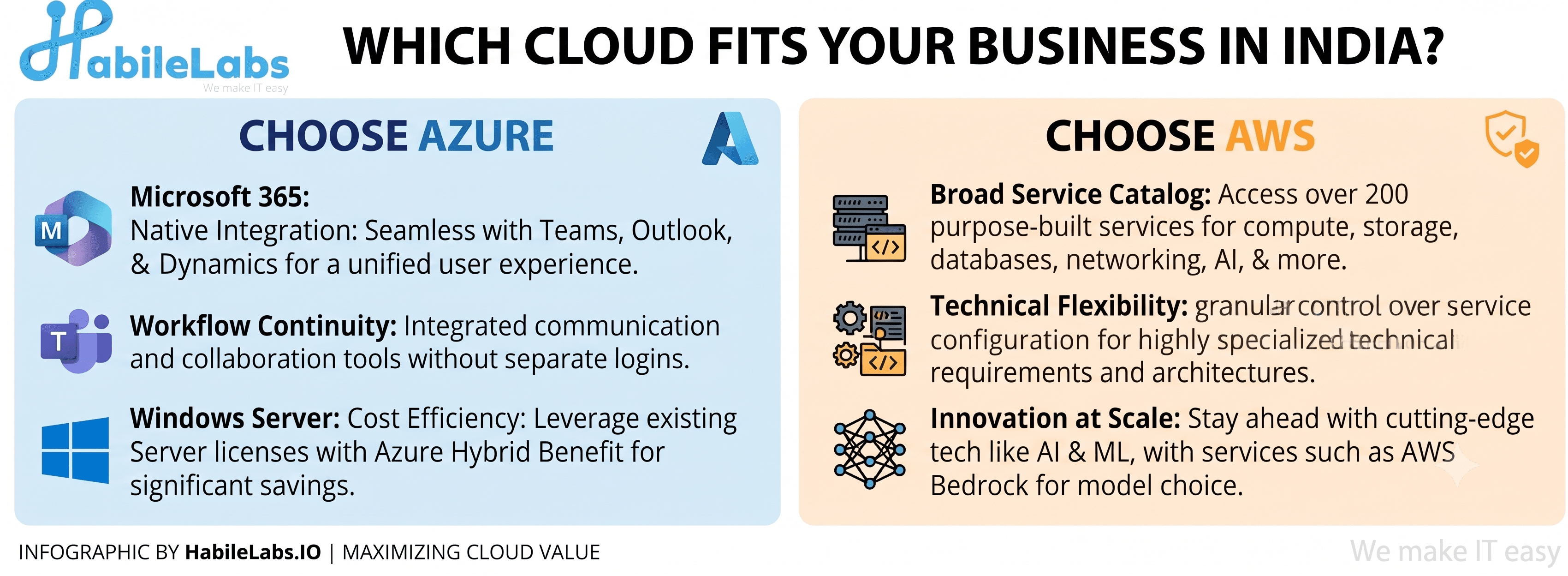
AWS holds approximately 31% of the global market share and operates at massive scale. That footprint translates into a catalog of over 200 managed services spanning compute, storage, databases, networking, artificial intelligence, and developer tools. This breadth proves invaluable when your operational needs are unusual. If you require a managed setup for a specialized database engine or a custom networking layout, AWS usually has a native solution.
Granular Control for Technical Teams
AWS gives developers and engineers deep, granular control over infrastructure configurations. This serves as a vital advantage for organizations with strong engineering teams. AWS Bedrock provides access to numerous fully managed open-weight and frontier-class models, giving technical departments flexibility that matches complex software architectures. For Indian technology startups building proprietary applications, that level of control is essential.
Cost Structures Tailored for Variable Workloads
Managing fluctuating traffic is another area where AWS excels. Through AWS Savings Plans India commitments, growing businesses can cap spending across compute and serverless resources while securing up to 72% off on-demand pricing. For volatile workloads that experience unpredictable spikes, this model prevents unexpected billing surges.
Where AWS Falls Short for Growing Businesses
Despite its versatility, AWS features a steep learning curve for non-technical users. Setting up and maintaining infrastructure requires specialized cloud expertise or outside partnership. Additionally, AWS lacks a native productivity suite equivalent to Microsoft 365, meaning businesses must manage separate integration layers for office and communication tools.
Evaluating Microsoft Azure: Ecosystem Integration and Rapid AI Adoption
While AWS rewards heavy technical engineering, Azure wins over traditional businesses by integrating smoothly into existing software environments.
The Microsoft Ecosystem Advantage
This is Azure's strongest differentiator for Indian businesses. If your organization already runs Microsoft 365, communicates via Teams, manages finances in Dynamics 365, or relies on Windows Server, Azure functions as a natural extension of those tools. Azure OpenAI Service provides secure, compliant access to advanced AI models that integrate natively with the broader Microsoft stack, enabling fast AI adoption without disrupting daily workflows.
Fast AI Deployment for Non-Technical Teams
For teams lacking dedicated data science departments, Azure removes common roadblocks. Azure Machine Learning offers guided workflows and drag-and-drop tools that accelerate deployment. If your goal is launching customer service chatbots or automated document summarization quickly, Azure bridges the gap to production efficiently.
Significant Savings via Azure Hybrid Benefit
Licensing economics create a massive financial advantage for Windows-heavy shops. By utilizing Azure Hybrid Benefit India deployments, businesses running Windows Server or SQL Server under Software Assurance can apply existing licenses directly to Azure virtual machines. This cuts compute costs by up to 85% compared to standard pay-as-you-go rates, a cost-saving mechanism that AWS cannot replicate for existing Microsoft license holders.
Where Azure Falls Short
Azure's pricing architecture becomes complex for organizations without existing Microsoft agreements. Standard on-demand rates are comparable to AWS, but optimization levers are less intuitive. Furthermore, Azure's management layer can feel opinionated, occasionally creating friction for teams deeply rooted in open-source ecosystems.
Feature-by-Feature Comparison: AWS vs Azure for Indian SMBs
| Feature / Criteria | Amazon Web Services (AWS) | Microsoft Azure | Best Suited For |
|---|---|---|---|
| Global & India Footprint | ~31% global market share; regions in Mumbai and Hyderabad. | Growing at ~30% YoY; regions in Pune, Mumbai, and Chennai. | Tie (Both meet Indian data residency and DPDPA requirements). |
| Primary Advantage | Broadest service catalog (200+ services) and deep technical flexibility. | Native integration with Microsoft 365, Teams, and Dynamics 365. | AWS: Custom engineering / Azure: Microsoft-heavy operations. |
| AI & Machine Learning | AWS Bedrock with extensive open-weight and frontier model choices. | Azure OpenAI Service with guided workflows and fast time-to-production. | AWS: Data science teams / Azure: Non-technical business teams. |
| Cost Optimization | AWS Savings Plans India commitments offering up to 72% off. | Azure Hybrid Benefit India licensing saving up to 85% on compute. | AWS: Variable custom workloads / Azure: Windows-heavy shops. |
| Learning Curve | Steeper learning curve; rewards advanced in-house cloud expertise. | Smoother onboarding for teams already familiar with Microsoft ecosystems. | AWS: Technical startups / Azure: Traditional business teams. |
Cost Snapshot: What This Actually Costs
Percentages are easy to quote and hard to picture. Here is roughly what three common SMB workload profiles cost per month on each platform, before any negotiated enterprise discount:
| Workload Profile (illustrative) | AWS - approx. monthly* | Azure - approx. monthly* | Notes |
|---|---|---|---|
| Small team (10–15 users): email, file storage, 1–2 line-of-business apps, light web hosting | ₹35,000 – ₹70,000 | ₹30,000 – ₹65,000 (lower if Microsoft 365/Windows licenses already owned) | Azure often cheaper here only with existing Software Assurance licenses. |
| Growing team (30–50 users): CRM/ERP workload, dev/test environment, moderate database use | ₹1,00,000 – ₹2,00,000 (before Savings Plan discounts) | ₹90,000 – ₹1,80,000 (before Hybrid Benefit discounts) | Reserved/Savings commitments and Hybrid Benefit change these materially — get a vendor-run estimate. |
| AI-enabled team: chatbot or document automation pilot, moderate model usage | Variable - depends on model choice and usage volume via AWS Bedrock | Variable - Azure OpenAI Service pricing tied to model + token volume | Pilot on a small usage cap before committing to production volume. |
Visual Guide to Choosing Your Platform
Decision Framework: Matching Your Business to the Right Cloud
Selecting the right environment requires aligning your daily software reality with each provider's core strengths.
When AWS Is the Cleaner Fit
- Your business employs a capable technical team or plans to scale dedicated engineering talent.
- Your workloads are technically specific, highly variable, or rely heavily on non-Microsoft stacks.
- You are building a core software product rather than just running standard business operations.
- Your artificial intelligence strategy demands granular model customization and custom pipelines.
When Azure Is the Cleaner Fit
- Your business operations are already anchored in Microsoft 365, Teams, Dynamics, or Windows Server.
- Your team lacks deep cloud engineering experience and requires simple, guided AI toolsets.
- You hold active Windows Server or SQL Server licenses under Software Assurance to maximize Azure Hybrid Benefit India discounts.
- You operate within highly regulated sectors where Azure's public sector track record provides reassurance.
Exploring a Multi-Cloud Strategy
Many growing organizations adopt a hybrid or multi-cloud architecture, utilizing Azure for core administrative productivity tools while deploying AWS for custom product development and specialized AI workloads. While this adds management layers, it prevents vendor lock-in.
Avoiding Common Cloud Migration Pitfalls
A successful cloud migration for Indian businesses depends on avoiding three classic mistakes:
- Choosing Solely on Sticker Price: Because base compute costs are similar, true financial efficiency depends on team fit. A mismatched platform incurs heavy hidden costs in outside consulting and employee friction.
- Starting Too Broad: Attempting to migrate an entire corporate infrastructure at once creates bloated timelines and budget overruns. The most successful implementations begin with one well-defined workload, validate its stability, and expand iteratively. For a typical SMB, migrating a single, well-defined workload (e.g., file storage, a line-of-business app, or email) usually takes 2 to 6 weeks; a full infrastructure move spans several months and should be phased accordingly.
- Treating the Decision as Permanent: While shifting platforms later requires effort, early choices do not lock you in forever. However, prioritizing correct initial fit saves substantial engineering hours.
How HabileLabs Helps Indian SMBs Navigate Cloud Decisions
As certified implementation partners across both ecosystems, HabileLabs approaches every cloud consultation objectively. We evaluate your current software stack, analyze your team capabilities, and map out your initial use cases to identify the best cloud for SMBs in India.
For teams choosing AWS, we handle configuration and ongoing management. For those selecting Azure, we manage seamless migrations, optimize licensing through Azure Hybrid Benefit India structures, and integrate productivity tools. Connect with the HabileLabs team today for an honest, tailored cloud fit assessment.