





Cloud-Based Application Development: Trends, Benefits, and Future Innovation
ByAnjali Jain

Introduction: Why Cloud-Based Applications Are the Future
In the modern digital world, businesses are rapidly migrating applications to cloud environments. Global cloud infrastructure spending hit $330 billion in 2024. Analysts expect the cloud computing market to reach $947 billion by 2026. This rapid growth shows that cloud-based application development is more than a trend. Companies of all sizes are using cloud scalability and innovation. Cloud-native apps are now the backbone of modern business technology.
But what exactly is a cloud-based app, and why should your organization consider it? In this article we will dive into the details of cloud computing services and cloud-based application development.
What is Cloud-Based Application Development?
Cloud-based application development refers to creating software applications that run on remote servers hosted in the cloud rather than on local machines. These apps, store data and perform processing on remote servers and are accessible via internet on various devices.
Cloud-based apps are categorized by the service models they use:
SaaS (Software as a Service):
SaaS is a cloud model where the provider fully manages and operates the product on behalf of the user. The provider takes care of maintenance, fixes issues, and performs routine updates. Common examples of SaaS include email marketing tools and CRM software.
PaaS (Platform as a Service):
In this, the cloud provider delivers both the hardware and the software platform, while the user remains responsible for managing the applications and the data they use. Developers use this service model to build apps without worrying about infrastructure maintenance.
IaaS (Infrastructure as a Service):
In this cloud service model, the cloud-based service provider managing the infrastructure, which covers networking, servers, and data storage. The user rents these resources and accesses them through a dashboard or an API.
By leveraging cloud services, businesses can focus on app features while offloading infrastructure management, maintenance, and security to cloud providers.
Types of Cloud-Based Applications
Cloud apps can be deployed in different cloud environments:
-
Public Cloud Applications: Hosted on shared infrastructure and accessible to many businesses. Cost-effective and easy to scale.
-
Private Cloud Applications: Dedicated infrastructure for a single organization, offering better security and control.
-
Hybrid Cloud Applications: Combine public and private clouds, balancing cost, scalability, and security.
-
Community Cloud Applications: Shared across organizations with similar compliance or regulatory requirements.
Choosing the right type depends on your organization’s security requirements, scalability needs, and budget.
Cloud-Based App Development Benefits
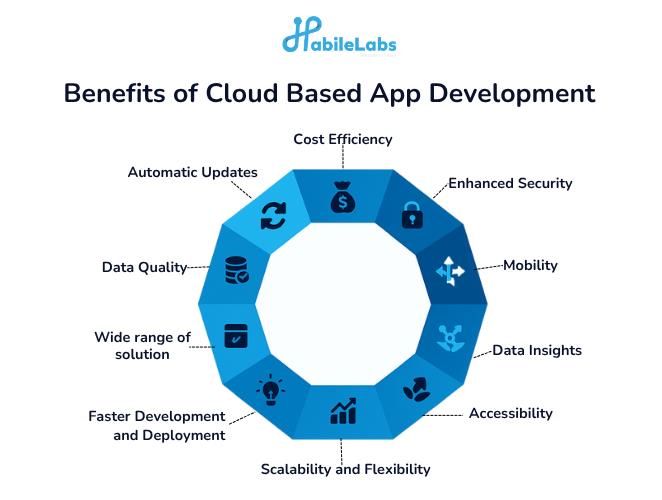
Investing in cloud-based app development offers several advantages:
1. Cost Efficiency
Cloud app development reduces upfront investments in servers, storage, and IT infrastructure. Pay-as-you-go pricing models allow businesses to pay only for the resources they use. This lowers their operational costs.
2. Scalability and Flexibility
Cloud apps can scale resources up or down depending on traffic and user demand. This flexibility ensures performance stability during peak periods without overpaying for unused resources.
3. Enhanced Security
Cloud providers implement advanced security measures such as encryption, firewalls, and multi-factor authentication. Data is regularly backed up and replicated across various servers to prevent loss.
4. Accessibility and Mobility
Cloud-based applications allow users to access data from anywhere with an internet connection. This improves collaboration, supports remote work, and enables real-time data sharing.
5. Faster Development and Deployment
Pre-built frameworks, APIs, and cloud services reduce development time. This enables businesses to bring products to market faster. Agile development methodologies can be integrated with cloud-based app solutions for continuous improvement.
6. Maintenance and Updates
Cloud providers manage server maintenance, software updates, and patches. With this, they reducing the burden on in-house IT teams.
7. Cross-Platform Compatibility
Cloud-based apps can function across various devices and operating systems, eliminating the need for separate apps for iOS, Android, and web.
8. Data-Driven Insights
Centralized data storage allows organizations to analyze user behavior, optimize performance, and make informed decisions using cloud analytics tools.
These benefits make cloud apps ideal for startups, SMEs, and large enterprises alike.
The Cloud-Based App Development Process
A structured cloud-based app development process ensures a secure, scalable, and high-performing application. Here’s a step-by-step guide:
Step 1: Need Analysis
Identify business goals, target users, and project scope. Conduct competitor research and define the functionality your cloud-based app must provide.
Step 2: Select Cloud Model & Service Type
Choose between SaaS, PaaS, or IaaS, depending on the app’s requirements and scalability needs. Decide on the deployment type (public, private, hybrid, or community).
Step 3: Choose Technology Stack
Select the appropriate tech stack, including development frameworks, cloud platforms (AWS, Azure, GCP), databases, and DevOps tools. Consider integrations with third-party APIs for enhanced functionality.
Step 4: Design & Architecture
Use scalable architectures like microservices or serverless models. Create wireframes, prototypes, and UI/UX designs to ensure smooth user experience.
Step 5: Development & Integration
Build the app modules, integrate APIs, and implement cloud services. Ensure security compliance with encryption, access control, and authentication protocols.
Step 6: Testing & Quality Assurance
Conduct rigorous functional, performance, and security testing. Optimize app speed and responsiveness for various devices.
Step 7: Deployment
Deploy the app on cloud servers or app stores. Follow guidelines for app review and approval processes, especially for mobile apps.
Step 8: Monitoring & Maintenance
Implement real-time monitoring, performance analytics, and regular updates. Continuously improve the app based on user feedback and usage data.
This systematic Cloud-Based App Development Process ensures a reliable, scalable, and secure application.
Best Practices for Cloud Application Development
Organizations can leverage cloud-based app development solutions across industries:
-
Enterprise Resource Planning (ERP): Centralized systems for managing business processes.
-
Customer Relationship Management (CRM): Streamlined customer data management and automation.
-
E-Commerce Apps: Scalable solutions for online shopping and transactions.
-
Collaboration Tools: Real-time team communication, project management, and file sharing.
-
AI & IoT-Enabled Apps: Intelligent solutions leveraging predictive analytics, sensors, and cloud data processing.
Future Trends in Cloud Application Development
As cloud technology advances, several key trends are driving the future of app development. Here are some of the most notable ones:
AI and Machine Learning Integration:
Cloud applications are increasingly embedding AI and machine learning to enhance user experience, automate workflows, and deliver more personalized services.
Edge Computing:
With the growth of IoT and cloud adoption, edge computing is becoming vital for reducing latency. By processing data closer to its source, cloud applications achieve better speed and efficiency.
Serverless Computing:
Companies are adopting serverless architecture for its scalability and ease of use. It enables developers to build applications without handling server management.
Hybrid Cloud Solutions:
More organizations are turning to hybrid cloud models, which merge private and public cloud systems. This approach combines scalability, compliance, and security to offer a strategic balance.
Staying updated with these trends ensures your cloud application development strategy remains competitive and forward-looking.
Conclusion: Is Cloud-Based App Development Right for Your Business?
Today, Cloud-based application development delivers cost efficiency, scalability, strong security, and valuable insights. With the right solution, businesses can innovate faster, and ensure long-term growth.
At HabileLabs, we help businesses use cloud technologies to boost efficiency, scalability, and innovation. Whether you need a SaaS solution or a PaaS platform, we deliver custom cloud apps tailored to your goals.
Partner with us to turn your ideas into secure, intelligent, and future-ready apps. This empowers your team to succeed in the digital era.