





Cloud Times 2025: When Cloud Became Unstoppable, and the Rules for 2026 Took Shape
ByAnjali Jain

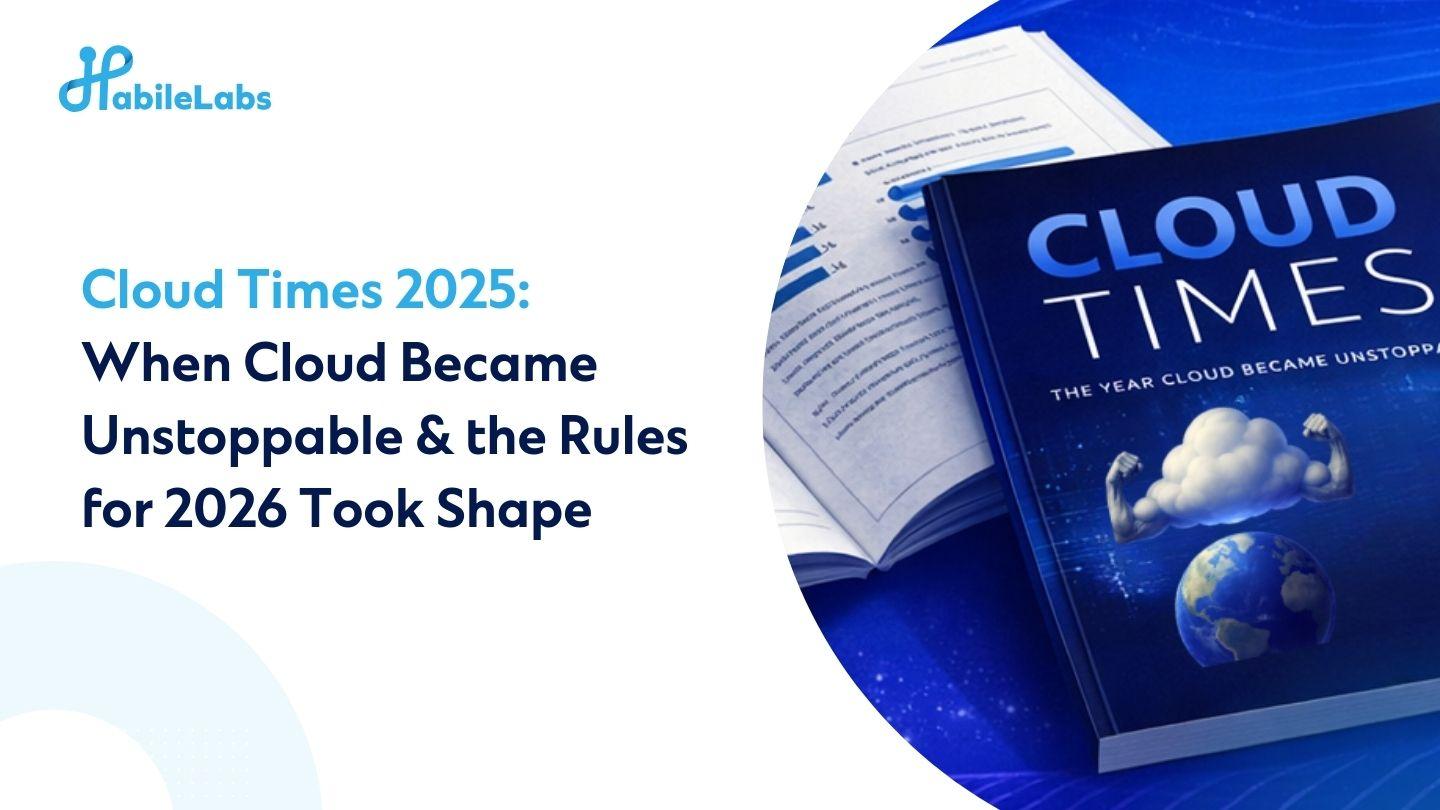
Cloud Times 2025 is HabileLabs’ year-end cloud report capturing the moment cloud crossed from adoption to inevitability. It examines how cloud, data, and AI converged in 2025 to reshape enterprise priorities around intelligence, compliance, and execution.
Grounded in real market shifts, enterprise behavior, and leadership decisions, the report distills what truly changed in cloud strategy, spending, and maturity. More importantly, it outlines how these changes are setting the operating model for 2026, where cloud is expected to lead decisions, not just support them.
Built for CEOs, CTOs, and business leaders, Cloud Times 2025 serves as both a reflection on the year that made cloud unstoppable and a strategic lens for navigating what comes next.
What Were the Top Cloud Services Trends in 2025?
Cloud services in 2025 moved decisively from experimentation to execution. Organizations moved beyond basic cloud migrations and began demanding measurable outcomes from their cloud investments.
The most significant cloud services trends in 2025 included:
- AI-driven decision-making at scale
- Automated cloud operations and self-healing systems
- Stronger security, governance, and audit readiness
- Multi-cloud and hybrid architectures built for resilience
What separated leaders from laggards was not cloud presence, but cloud maturity. The report highlights a widening gap between organizations that embedded governance, data readiness, and automation into their cloud architectures and those that treated cloud as a lift-and-shift exercise.
Why Did India Emerges as the Fastest-Growing Cloud Computing Markets in 2025?
India’s position in the global cloud industry changed fundamentally in 2025. Long known as a talent hub, India emerged as a cloud execution powerhouse. Cloud investments have increased. Data centers have expanded. Enterprises raised cloud budgets. Regulations pushed companies to modernize faster.
The report highlights how compliance frameworks such as DPDP, RBI cloud governance, UIDAI data hygiene, and healthcare data standards reshaped cloud architectures. As a result, global hyperscalers and enterprises started treating India as a launchpad rather than a backend location.
Which Industries Led Cloud Adoption and AI Integration in 2025?
BFSI and Healthcare accelerated faster than most sectors, but the reasons go beyond adoption of metrics. In BFSI, legacy systems struggled under compliance demands, AI adoption needs, and resilience expectations. Cloud-ready institutions gained measurable advantages in automation, fraud detection, and regulatory confidence.
In Healthcare, cloud became the backbone for elastic infrastructure, AI-ready data pipelines, zero-downtime operations, and secure patient ecosystems. Organizations that embedded compliance and intelligence directly into their architectures moved ahead of those treating cloud as a technology upgrade.
How Will Cloud Computing Evolve in 2026 and Beyond?
The most significant shift ahead is not technological. It is operational. Cloud platforms are expected to:
- Automate core operations
- Predict and mitigate risks before impact
- Deliver industry-specific intelligence
- Support AI-native applications by default


The critical questions are how fast this transition will happen, which industries will lead, and which capabilities will matter most. The answers are grounded in projections, expert commentary, and strategic signals examined in detail.
What Is the Success Code for Leaders in 2026?
In 2026, success will not come from cloud alone. The organizations that pull ahead will be those that treat cloud as the foundation, data as the source of truth, and AI as the multiplier. Cloud enables scale and resilience. Data enables visibility and trust. AI turns both into speed, intelligence, and competitive advantage.
HabileLabs’ Cloud Times 2025 helps leaders understand where their organization stands on this equation today, what gaps need attention, and how the decisions made now will determine whether cloud becomes a cost center or a leadership advantage in 2026.
For business and technology leaders, the report is not a forecast. It is a lens to understand where cloud stands today, why it matters now, and what must come next.
What Cloud Times Ultimately Offers To Leaders?
For CEOs and CTOs, Cloud Times 2025 offers clarity. It brings together data, trends, and strategic implications into a single, structured view of how cloud actually performed in 2025 and how those decisions are shaping 2026. Instead of tracking noise, the report focuses on what materially changed in cloud services, cloud spending, and enterprise behavior.
Inside the report, leaders will find global and India-specific cloud insights, clear maturity benchmarks across industries, and forward-looking perspectives on how cloud services and spend are expected to evolve in 2026. It also translates these shifts into practical guidance for CIOs, CTOs, and digital leaders who are accountable for outcomes, not experimentation. At its core, the report answers a critical leadership question.
Planning Your Cloud Strategy for 2026?
If you’re planning your next phase of cloud transformation, our team is ready to help.
HabileLabs – Your Partner in Cloud Intelligence
- Email: info@habilelabs.io
- Website: www.habilelabs.io