





How Generative AI Can Transform Your Document Management Process
ByAnjali Jain

Today, dealing with a ton of information can be tough for companies. There's so much data out there that businesses need to find better ways to manage their documents. As per IDC, the global data sphere will grow to 175 zettabytes by 2025. With this surge, managing documents manually or using legacy document management systems (DMS) is becoming inefficient and unsustainable. A report from Gartner says that by 2026, more than half of companies will use AI to help automate their document processes, a big jump from only 10% in 2021. This shows that Generative AI is becoming a key tool for businesses, making it easier, quicker, and more accurate to handle their paperwork.
Understanding Generative AI in Document Management
Generative AI is when machine learning models create new content. They do this by using patterns and input data they have learned. In the context of document management, it goes beyond basic automation. It can create, summarize, categorize, and intelligently route documents, freeing up valuable human resources for more strategic tasks.
This form of AI excels at automating repetitive tasks such as:
-
Document creation: Automatically generating templates, contracts, and reports.
-
Document routing: Automatically routing documents to the right stakeholders based on context.
-
Summarization: Extracting key points and creating summaries from lengthy documents for quick reference.
For organizations seeking to improve efficiency, this technology offers a comprehensive solution that reduces manual intervention while increasing productivity.
Now Let’s dive into how Generative AI is transforming the document management landscape:
Streamlining Document Creation and Drafting
One of the most significant impacts of GenAI lies in its ability to assist with document creation. Instead of starting from a blank page, users can leverage GenAI to draft initial versions of various documents.
-
Policy and Procedure Generation: GenAI can analyze existing policies, regulatory requirements, and best practices to generate drafts of new policies or procedures, significantly reducing the time and effort involved in initial drafting. For instance, if your organization needs to create a new data privacy policy, GenAI can synthesize information from GDPR, CCPA, and your existing internal guidelines to produce a comprehensive first draft.
-
Contract Drafting and Review: GenAI can assist in drafting standard contract clauses, reviewing existing contracts for compliance, and identifying potential risks or inconsistencies. Imagine uploading a template for a service agreement; GenAI could automatically fill in standard clauses and highlight areas that need specific attention or customization based on previous agreements.
-
Report Generation: By feeding GenAI with relevant data, it can generate comprehensive reports, including summaries, key findings, and even visualizations. This can be particularly useful in finance, marketing, and sales departments, where data analysis and reporting are frequent tasks.
Enhancing Document Understanding and Summarization
The ability of GenAI to understand the context and meaning of text opens up new possibilities for processing and leveraging information contained within documents.
-
Automated Summarization: GenAI can automatically generate concise summaries of lengthy documents, allowing users to quickly grasp the key information without having to read through entire files. This is invaluable for staying updated on project reports, legal documents, or research papers. For example, a 50-page project proposal can be summarized into a one-page executive summary, highlighting the core objectives, strategies, and expected outcomes.
-
Topic Extraction and Categorization: GenAI can identify the main topics discussed within a document and automatically categorize it accordingly. This improves document organization and makes it easier to retrieve relevant information later. Imagine a system that automatically tags customer feedback documents with topics like "product feature request," "bug report," or "customer service issue," enabling efficient routing to the appropriate teams.
-
Question Answering: GenAI-powered systems can answer specific questions based on the content of uploaded documents. Instead of manually searching for an answer within a long report, users can simply ask a question and receive a direct, contextually relevant response.
Revolutionizing Information Retrieval and Search
Traditional keyword-based searches often yield irrelevant results and require users to sift through numerous documents to find what they need. GenAI can significantly enhance information retrieval by understanding the intent behind search queries.
-
Semantic Search: GenAI can understand the meaning and context of search terms, returning results that are conceptually related to the query, even if the exact keywords are not present. For instance, searching for "customer complaints about website navigation" could return documents that mention "difficult site usability" or "frustrating user experience."
-
Conversational Search: Integrating GenAI with AI Teammate allows users to interact with document repositories using natural language. Users can ask questions and refine their search through conversation, making the information retrieval process more intuitive and efficient.
-
Cross-Document Analysis: GenAI can analyze information across multiple documents to identify patterns, connections, and insights that might not be apparent when examining individual files. This can be valuable for tasks like legal discovery, market research, or competitive analysis.
Improving Data Extraction and Analysis
Extracting structured data from unstructured documents has traditionally been a manual and error-prone process. GenAI offers sophisticated solutions for automating this task.
-
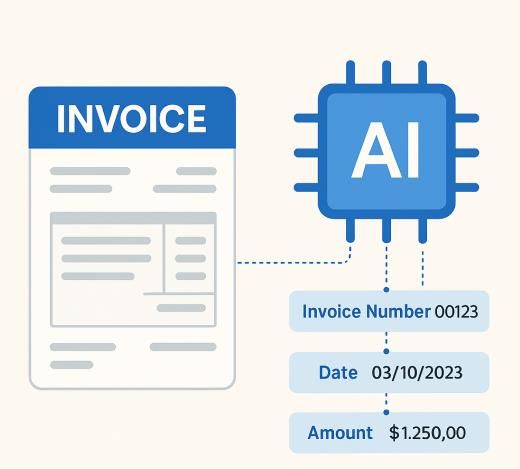
Intelligent Data Extraction: GenAI can identify and extract key information from various document types, such as invoices, purchase orders, and contracts, even if their layouts differ. This extracted data can then be used for automated data entry, analysis, and integration with other business systems. For example, an AI system could automatically extract vendor names, invoice numbers, amounts, and due dates from a batch of invoices, eliminating the need for manual data entry into accounting software.
-
Named Entity Recognition: GenAI can identify and categorize specific entities within documents, such as names of people, organizations, locations, and dates. This can be useful for compliance checks, risk assessment, and customer relationship management.
-
Sentiment Analysis: GenAI can analyze the sentiment expressed in text documents, such as customer reviews or feedback forms, providing valuable insights into customer opinions and experiences.
Enhancing Document Security and Compliance
Generative AI can also play a crucial role in improving document security and ensuring compliance with regulatory requirements.
-
Automated Compliance Checks: GenAI can analyze documents to ensure they comply with relevant legal and regulatory frameworks, flagging any potential violations or inconsistencies. For example, it can check if contracts contain mandatory clauses or if data handling procedures adhere to privacy regulations.
-
Access Control and Anomaly Detection: By understanding document content and user behavior, GenAI can help enforce access controls and detect anomalous activities that might indicate security breaches or unauthorized access attempts.
-
Data Masking and Anonymization: GenAI can automatically identify and mask sensitive information within documents, such as personal data or financial details, to protect privacy and comply with data protection regulations.
Addressing the Challenges of Implementation
While the potential of GenAI in document management is immense, organizations need to be mindful of the challenges associated with its implementation.
-
Data Quality and Bias: The performance of GenAI models heavily relies on the quality and representativeness of the training data. Biased data can lead to inaccurate or unfair outcomes. Ensuring data quality and mitigating bias are crucial for successful GenAI adoption.
-
Integration with Existing Systems: Integrating GenAI-powered document management solutions with existing IT infrastructure and workflows can be complex and may require significant investment in terms of time and resources.
-
Security and Privacy Concerns: Handling sensitive documents with AI systems raises concerns about data privacy and security. Robust security measures and compliance with data protection regulations are paramount.
-
Cost and Expertise: Implementing and maintaining GenAI solutions can be expensive and may require specialized expertise in AI and machine learning.
The Future of Document Management with Generative AI
The future of document management is inextricably linked with the advancements in Generative AI. We can expect to see even more sophisticated applications emerging, including:
-
Hyper-Personalized Document Experiences: GenAI could tailor document formats, content summaries, and even language based on individual user preferences and roles.
-
Predictive Document Management: AI could predict future document needs based on past behavior and proactively organize and present relevant information.
-
Seamless Integration with Collaborative Platforms: GenAI-powered document management will likely be seamlessly integrated with collaboration tools, enhancing teamwork and knowledge sharing.
-
Autonomous Document Workflows: AI could automate entire document workflows, from creation and review to approval and archiving, with minimal human intervention.
Conclusion:
Generative AI holds the key to unlocking a new era of intelligent document management. By automating tedious tasks, enhancing understanding, improving retrieval, and bolstering security, GenAI can empower organizations to transform their document processes from cumbersome obligations into strategic assets. While challenges exist, the potential benefits in terms of efficiency, accuracy, and insight are too significant to ignore. As GenAI continues to evolve, businesses that embrace its capabilities will gain a significant competitive advantage in the data-driven world. HabileLabs is committed to helping organizations like Aavas, navigate this transformative landscape and leverage the power of Generative AI to revolutionize their document management practices.