





NBFC DPDP Compliance by 2027: Why Document Governance Proof Matters
BySaloni Seth

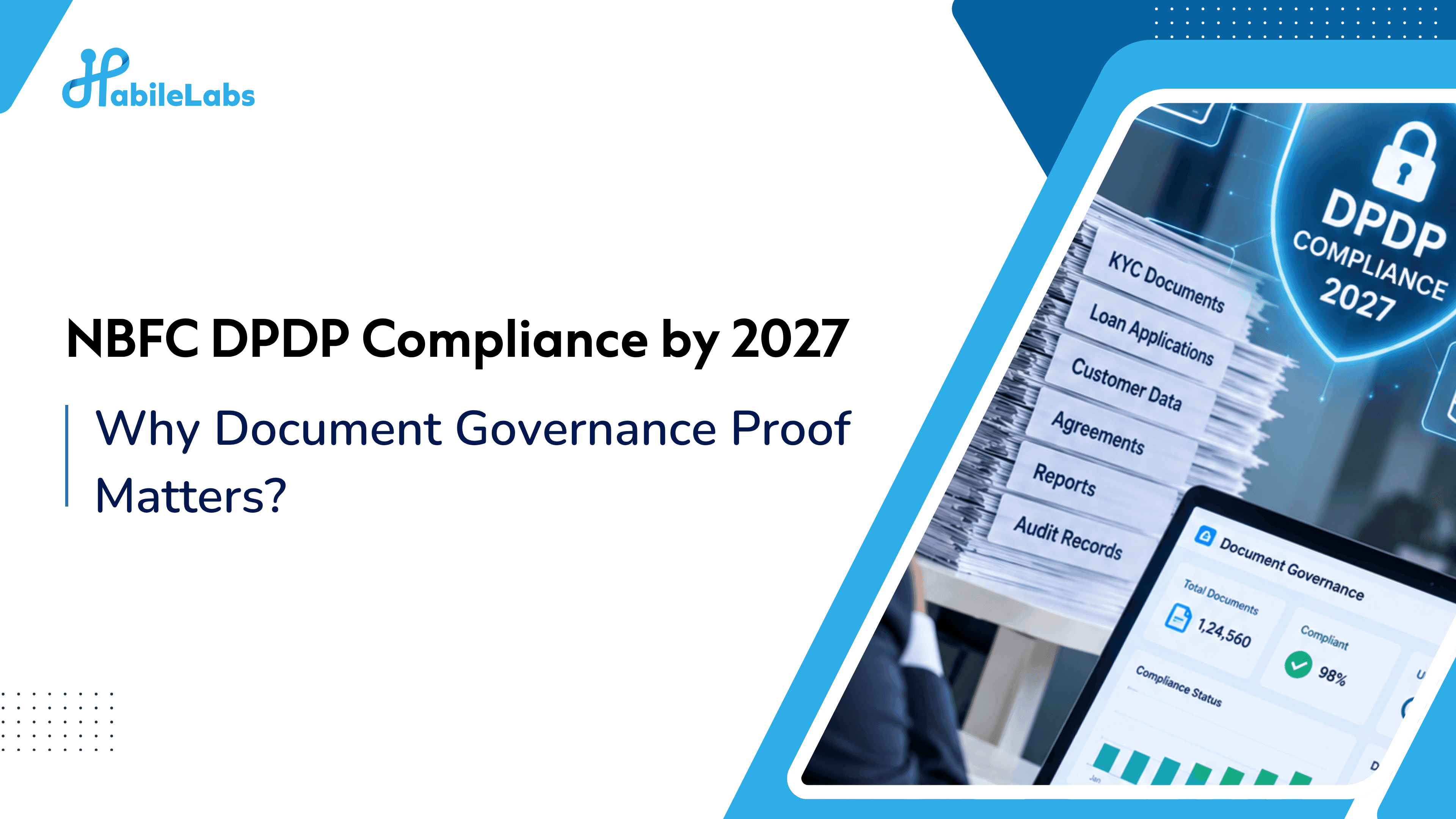
TL;DR: For NBFC DPDP compliance by 13 May 2027, any NBFC should be able to show, not assume, what personal data resides in its papers, who can access it, and whether sensitive data like Aadhaar is concealed. That is around 20 months from now. Most NBFCs think they are further along than they are, based on six specific fallacies about what DPDP preparedness actually means. This article walks through each one.
Why NBFCs Must Prove DPDP-Ready Document Governance
By 2027, all NBFCs, regardless of size, segment, or how modernised their systems already are, will have to be able to provide on demand: a detailed list of the personal data within their document estate, evidence of access control and monitoring, and confirmation that sensitive data is hidden. For NBFC data privacy teams, this is not just something to speak about — it must be proven.
That’s not a forecast. It is what the DPDP Act for NBFCs and DPDP Rule 3 and Rule 6 already indicate. Notified by MeitY on 13 November 2025, it comes into force eighteen months later, on 13 May 2027.
The gap is not awareness of the deadline. Most compliance and IT teams know it exists. The gap is a series of assumptions about what “ready” means — assumptions that seem acceptable, but turn out to be inaccurate when examined.
6 Myths About NBFC DPDP Compliance and Document Governance Readiness
| Myth | Fact |
|---|---|
| “We keep our documents safe, so we’re good.” | Storage security is not the same as DPDP readiness. Rule 6 requires access logs, monitoring, review, and masking — not merely that a system is secure. If a DMS has no access logging and Aadhaar is unmasked, it is not compliant. |
| “We’ll deal with it closer to May 2027.” | Rule 6 calls for masking and access control across older repositories, not just new documents. Years of historical scans, files, and branch archives on shared drives cannot be remediated in a sprint close to the deadline. |
| “This is an IT and compliance issue; operations does not need to be involved.” | Rule 3 means the personal data inventory needs to be based on understanding what documents exist and what is inside them — knowledge that often resides with operations and branch teams, not simply IT. |
| “Our legacy archive doesn’t really count - it’s old data, not active processing.” | Rule 6 does not distinguish between active and historical data based only on age. If an unmasked Aadhaar sits in a scanned file that is five years old and still retained, it remains personal data in scope. |
| “Masking Aadhaar is the whole job.” | Masking is one of the stated protections in Rule 6, alongside access control, logging, and monitoring. An NBFC that hides Aadhaar but has no access-log review or consent traceability has completed only one part of the requirement. |
| “This mainly affects large NBFCs with large loan books.” | The processing of personal data triggers Rule 3 and Rule 6, not the size of the loan book. Smaller NBFCs and digital lenders with KYC, Aadhaar, and financial data in documents have the same requirement, often with fewer dedicated compliance resources. |
What DPDP Compliance Proof Means for NBFC Document Management
For document governance to be ready, you must be able to answer these on request, not eventually to be ready by May 2027:
- An itemised inventory of personal data categories in your document estate, matched to purpose under Rule 3.
- Documented and inspected access logs for all systems with access to client documents, not only the main DMS.
- Consistent masking between new inflow and historical repositories under Rule 6.
- A verifiable record of consent for how each type of document is utilised.
- The ability to obtain any individual document rapidly, as already anticipated by RBI’s KYC Master Direction, irrespective of DPDP.
All of these are discussed in more detail in Part 1 of this series, linked below.
Why the DPDP 2027 Deadline Is Closer Than NBFCs Think
Today is approximately 20 months until 13 May 2027. That sounds like time. Once the actual task is broken down, it isn’t:
- Creating a personal data inventory across a multi-branch document estate takes months, not weeks - especially where papers were never filed with this requirement in mind.
- Access logging and review for every system, not only the newest one, is an infrastructure upgrade, not a policy statement.
- The biggest time sink, which most NBFCs are underestimating today, is Aadhaar masking across old archives, potentially years of scanned documents across branches.
Waiting until 2027 to begin this repair means waiting until there may no longer be enough runway left to complete it well.
NBFC DPDP Compliance Self-Check: Is Your Document Estate Ready?
- Do you have a current list of personal data categories in your documents, not a vague feeling, but an actual itemised inventory?
- Are access to Aadhaar and PAN data recorded and audited for all systems where data exists, including branch systems?
- Is Aadhaar masked in your legacy archives, or only in papers collected going forward?
- If a regulator asked you for proof of any of the above tomorrow, could you provide it, or would you have to create it first?
- Is this the role of one clearly responsible team, or are you assuming it is “someone’s job” without it being anyone’s explicit mandate?
If the answer is “we’d need to build that”, the runway until 13 May 2027 is shorter than it looks.
How HabileLabs Supports NBFC DPDP Compliance and Document Governance?
HabileLabs works with regulated lenders on this exact gap - moving document infrastructure through digitisation, storage and retrieval, governance, and intelligence, with DPDP Rule 6 alignment such as access control, audit trails, and masking across both live and legacy repositories built into the governance stage.
We are not saying that any technology can ensure compliance that is the role of your compliance division. The objective is to make your document infrastructure capable of generating the proof Rule 3 and Rule 6 will request, when they request it.
For instance, HabileLabs’ work with Aavas Financiers included more than 35 TB of financial information, AWS-native infrastructure, data masking, and disaster recovery, the same types of preparedness work mentioned above.
HabileLabs brings together:
-
Enterprise Document Management System: Digital document lifecycle management.
-
Document Intelligence: Insights and value from your documents.
-
AI-enabled PII Management: Discover, classify, and manage PII data to facilitate DPDP compliance.
With HabileLabs, turn your document environment into an intelligent, secure, and compliance-ready foundation.
Begin your NBFC DPDP compliance and document governance preparedness journey with HabileLabs. Contact us for further details.
Next Step: A Document Infrastructure Assessment gives you a straight read on where your document estate stands against Rule 3 and Rule 6 today, and a realistic understanding of what bridging the gap by May 2027 will take for your unique systems and branch footprint.
Read More on DPDP Compliance, Document Management, and Document Intelligence for NBFCs
Part 1: DPDP Compliance for NBFCs – What Rule 6 Actually Says
Part 2: Document Management System Comparison for NBFCs
Part 3: Document Intelligence for NBFCs – Trends and Hacks for 2026