





The Consequences of Neglecting Cloud Optimization for Enterprises in 2025
ByAnjali Jain


Table of contents
Cloud computing continues to redefine how enterprises operate and scale. As per Gartner, global public cloud investment is projected to reach $723.4 billion by 2025. While this surge reflects growing digital goals, it also brings a difficult challenge: cloud optimization.
Many organizations are making substantial investments without a strategy to manage cloud efficiency. The consequences are more than financial as they impact performance, compliance, and long-term competitiveness.
In this blog, we examine the key risks of neglecting cloud optimization and the real-world impact across industries.
1. Spiraling Costs and Wasted Spend
Unchecked cloud usage leads directly to overspending. This is no longer a hidden issue -
-
69% of organizations reported cloud budget overruns in 2023, and the problem is growing.
-
A 2025 Flexera study found that 84% of people have trouble managing cloud spending. This is happening even as cloud budgets grow quickly.
The root cause of these overruns?
Idle or excess resources. Enterprises estimate that 21% of their cloud infrastructure spend goes to underutilized or unused resources, according to Harness research. Imagine paying for a huge office building but only using a few rooms. That's what happens in the cloud.
A lack of visibility plays a significant role in this. A CloudZero survey highlighted that only 30% of organizations know where their cloud budget is going. Developers often overprovision by default and consider cost optimization to be “someone else’s problem.” In fact, only 32% of engineering teams have implemented automated cost-saving policies such as shutting down idle servers.
Less than half can monitor orphaned or idle resources in real-time. This disconnect means expenses quietly grow until the bill arrives, and it's much higher than expected. If companies do not ensure they use resources wisely, they almost always go over budget.
How to Fix this:
The opportunity cost of this inefficiency is significant. Every dollar wasted in the cloud is a dollar that could go to innovation, product development, or better pricing. In contrast, companies that implement FinOps (financial operations for the cloud) report substantial savings and increased visibility. If you don't optimize, cloud spending turns from something that helps your business into a financial burden.
2. Performance and Reliability Risks
Beyond cost, neglected cloud optimization directly impacts system performance and reliability. Overprovisioned or mismatched infrastructure—such as large virtual machines (VMs) running idle or inadequate bandwidth during peak usage—leads to bottlenecks, inefficient usage, and even downtime.
Without optimization, businesses face slower deployments, outages, and extended recovery times. Downtime is particularly expensive. According to Accenture (via CloudZero), 40% of enterprises report losses of $1–5 million for every hour of unplanned downtime.
Crucially, misconfiguration is a leading cause of outages. Infrastructure that is not properly sized or tuned affects internal teams and customers alike, reducing productivity and trust. Sluggish performance also has broader implications.
Data-intensive processes such as AI model training or analytics workloads require high-performance cloud setups. When organizations run these workloads on poorly optimized cloud infrastructure, it results in wasted time and costs which you’re paying for speed and scalability. Over time, these inefficiencies build up and slow down new product ideas and innovation.
3. Security and Compliance Risks
Security is often cited as a benefit of the cloud, but only if managed correctly. In reality, misconfiguration is a major and consistent source of risk in cloud environments.
The data is alarming:
-
68% of public cloud security incidents are caused by misconfigurations (Fortinet).
-
23% of cloud incidents are linked to misconfigured assets (SentinelOne).
-
27% of organizations have suffered a public cloud breach.
Impacts:
-
Exposed data: These misconfigurations often expose sensitive data - such as unsecured storage buckets or poorly managed access permissions. Most of these issues stem from human error, reinforcing the need for continuous cloud cost optimization and oversight.
-
Severe Financial and Legal Consequences: The cost of a cloud data breach can be very high, even more so in regulated industries. Beyond financial losses, companies face huge fines from regulators (e.g., under GDPR, fines can be up to 4% of global annual revenue).
-
Blurry Security Boundaries: Unoptimized cloud environments often have unclear security lines. Poor configuration management leads to breaking industry rules (like HIPAA, PCI-DSS) or national data laws.
4. Governance and Operational Inefficiencies
Neglecting optimization goes hand-in-hand with poor governance, leading to disjointed operations and strategic drift. A 2024 study showed 63% of IT leaders struggle to manage cloud resources due to the absence of governance frameworks.
This lack of oversight results in:
- Duplicate environments
- Resource sprawl
- Ineffective budget allocation
Multi-cloud environments and legacy system integrations further complicate the picture. PwC’s US Cloud Business Survey revealed that integration challenges and limited expertise were key barriers to unlocking cloud value.
Organizational misalignment is a recurring theme. Often, developers provision infrastructure while finance teams manage budgets - without visibility into one another’s actions. This lack of coordination makes cost controls and governance tools like tagging, monitoring, and automated shutdowns. This hinders accountability, prevents prioritization of high-impact workloads, and results in bloated, inefficient architecture.
5. Competitive and Strategic Disadvantages
Finally, ignoring cloud cost optimization carries long-term strategic costs. Companies burdened with technical debt, inflated costs, and unmanaged cloud infrastructure are slower to respond to market shifts and innovation opportunities.
If one organization's cloud bill is 30% too high, its competitors benefit. They can use that money for research, getting new customers, or speeding up delivery. Without optimization, even scaling operations become cumbersome, relying on manual fixes instead of elastic infrastructure.
On the other hand, organizations that embed FinOps early often realize significant benefits. Case studies indicate up to 40% cost savings over three years and faster innovation cycles. Wasted infrastructure also eats into engineering productivity. Instead of developing customer features, teams spend time troubleshooting costs or chasing down performance issues.
In essence, cloud waste doesn’t just cost money—it stalls progress. In a market that rewards speed, agility, and lean operations, unoptimized cloud strategies become a clear disadvantage.
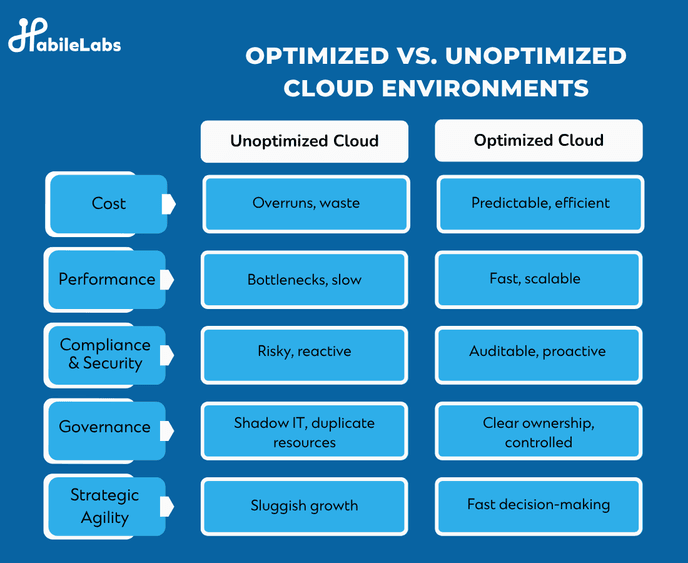
Conclusion: Cloud Optimization Is No Longer Optional
By 2025, cloud inefficiencies are too costly to ignore. Enterprises that fail to optimize risk:
- Massive budget overruns
- Performance slowdowns and outages
- Regulatory breaches and security risks
- Stalled innovation and strategic setbacks
The solution lies in treating cloud optimization as a continuous strategic process. This includes:
- FinOps for financial visibility
- Cloud governance for control
- Technical optimization for performance and security
At HabileLabs, our AWS-certified architects and cloud experts are dedicated to helping your business fully optimize its cloud infrastructure and unlock its maximum potential. With our AI-powered platform, Refine by HabileLabs, you can stay ahead of the curve in cloud cost management.
Refine is a free, intelligent tool designed to uncover hidden overspending and reduce your AWS bills by up to 40%, without guesswork. Whether you're scaling operations, preparing for audits, or striving for better budget predictability, Refine simplifies cloud optimization and delivers actionable insights.
Book a free consultation today and discover how Refine, backed by our certified AWS experts, can transform the way you manage and optimize your cloud resources.