






Why Most Cloud Transformations Fail Before They Begin
The cloud promises speed, cost savings, and innovation. Yet for seven out of ten organizations, these benefits never materialize. The issue is not the cloud itself. It is how organizations begin the journey. Many financial institutions rush to migrate systems to the cloud expecting instant transformation. Instead, they carry forward outdated architectures, security gaps, and compliance risks into a more expensive environment. For banks and insurers operating under strict regulatory frameworks, this approach is not just inefficient. It introduces serious operational and regulatory risk.
Moving to the cloud without a proper assessment is like building a house without inspecting the foundation. A cloud assessment provides a clear and strategic view of the existing IT landscape, ensuring cloud adoption is guided by insight rather than assumption. True cloud confidence does not come from adopting new technology. It starts with understanding what the organization is building on.
What Do Enterprises Get Wrong About Cloud Modernization
Many organizations assume that cloud migration is the same as modernization. But just lifting old systems and moving them to a new environment doesn’t solve much. In fact, it often moves old problems into a more expensive and complex setup.
Without a structured cloud assessment, you may:
-
Over-provision resources and overspend
-
Miss critical access or encryption controls
-
Fail to meet regulatory compliance standards
Enterprises often treat cloud modernization as a speed-driven migration, overlooking embedded risks in legacy lift-and-shift setups. From an architectural perspective, these failures usually stem from unexamined issues such as:
- Highly coupled, synchronous dependencies
- Stateful monolithic applications
- Legacy integrations unsuited for hybrid or distributed environments
True modernization requires dissecting existing architectural debt before migration. A strong cloud assessment helps separate smart cloud modernization from rushed cloud migration.
Why Assessment Is the Foundation of a Confident Cloud Strategy
From an architectural perspective, most cloud initiatives fail not due to tooling limitations or budget constraints, but because foundational decisions are made without fully understanding the existing system landscape. A cloud assessment is not a procedural step performed before migration. It is the architectural lens through which every cloud decision should be evaluated. At a senior architecture level, it answers a critical question. What constraints and opportunities do the current system impose on the future cloud state?
Without this clarity, organizations default to lift and shift migrations, replicating on premise inefficiencies in the cloud. This often results in higher costs, increased operational complexity, and limited long-term value.
What a Cloud Readiness Assessment Really Means
A cloud readiness assessment evaluates an organization’s infrastructure, applications, data, security, and operational processes to determine how prepared it is for cloud adoption. It identifies gaps, risks, and improvement areas needed for a secure and effective transition. A meaningful assessment goes beyond listing servers or applications. It focuses on how systems behave under real operating conditions rather than how they appear in documentation. It examines user access patterns, workload spikes, system failures, and recovery behavior. This helps organizations understand application dependencies, performance bottlenecks, and how costs scale with usage. A comprehensive cloud assessment evaluates:
- How systems run day to day, not just how they are designed
- How applications depend on each other, and what happens if one part fails
- How performance changes under heavy load, such as peak business hours
- How security, access, and identities are connected across systems
- Where costs really come from, based on how applications are used
How Does a Cloud Assessment Help Reduce Risk in BFSI
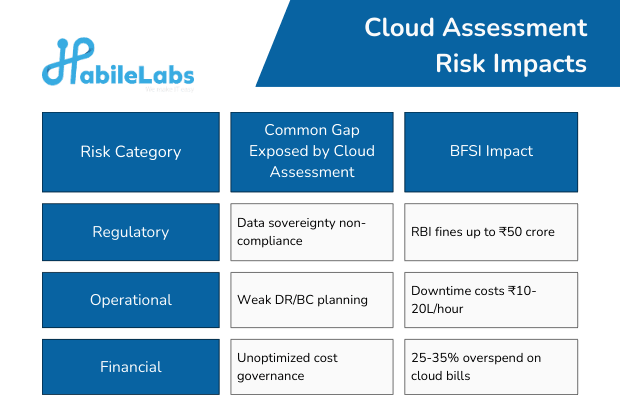
A proper cloud assessment helps financial institutions reduce risk in several critical areas:
1. Regulatory Compliance:
Cloud assessments evaluate alignment with RBI, IRDAI, DPDP Act, and international compliance standards. They verify whether: - Data resides within approved jurisdictions - Sensitive information is encrypted at rest and in transit - Audit trails, logs, and access records are reliable and tamper-proof. By mapping data flows and access controls, assessments proactively surface compliance gaps before audits do.
2. Operational Resilience:
While the cloud promises high availability, resilience only materializes when systems are architected correctly. Assessments validate: - Backup frequency and geographic distribution - Failover readiness across zones or regions - Recovery plans that are realistic and tested. For BFSI institutions, this directly supports Disaster Recovery readiness, critical during seasonal disruptions and infrastructure failures.
3. Financial Control:
Uncontrolled cloud spending is a common post-migration shock. Cloud assessments provide visibility into: - Idle or underutilized resources - Over-provisioned compute and storage - Missing automation in scaling and shutdown. Many assessments uncover cost inefficiencies inflating cloud bills by 30–40%, enabling immediate FinOps corrections.
4. Risk Management:
A cloud assessment highlights risks and ranks them. It helps prioritize fixes and guides better planning. Whether it’s data security, downtime, or non-compliance, it enables leadership to stay ahead of potential threats. Cloud assessment transforms vague risks into actionable priorities.
What Exactly Is Reviewed in a Cloud Assessment for BFSI Institutions?
A thorough cloud assessment goes beyond surface-level reviews. It examines the following:
Security Architecture:
-
Are firewalls, encryption, and access controls properly set up?
-
Is sensitive data protected both in storage and during transfer?
Identity and Access Management (IAM):
-
Are user roles and permissions clear and enforced?
-
Is multi-factor authentication (MFA) in place for all sensitive systems?
-
Does IAM align with zero-trust principles?
Disaster Recovery and Backup:
-
Are backups stored in multiple zones?
-
Have failover plans been tested in real scenarios?
Cost Governance:
-
Are cloud resources tagged properly by project or department?
-
Are spending thresholds and alerts defined?
-
Is accountability for cloud usage clearly assigned?
Technical Debt and Legacy Systems:
-
Are old systems simply moved to the cloud without optimization?
-
Do monolithic or stateful workloads require refactoring or redesign?
-
How much do these systems add to cloud costs or risks?
These dimensions collectively determine whether a cloud environment is resilient, compliant, and scalable.
Why Are Focused Cloud Assessments More Effective Than Big Plans
Organizations don’t need months-long strategy documents to understand their cloud risks. A focused cloud assessment, typically completed in 7–10 days, can quickly answer high-impact questions: Are we audit-ready? What happens during a cloud outage? Are we overspending? Which applications need redesign or retirement? Short assessments deliver - Prioritized risk lists, Immediate cost-saving opportunities and Clear, actionable recommendations. For BFSI leaders operating under tight audit cycles, this speed and clarity are invaluable.
What Should BFSI Leaders Do Next to Strengthen Their Cloud Strategy
Cloud success in banking and finance depends on confidence, not speed. And confidence starts with clarity. Whether you're facing a regulatory audit, a data center migration, or just rising cloud bills, a focused assessment can give your leadership team the insight it needs.
If these questions resonate, a focused Cloud Modernization Risk Assessment is the safest place to start. HabileLabs helps BFSI institutions modernize securely and responsibly through strategic cloud guidance - turning cloud assessments into confident, compliant cloud strategies.