





The Ultimate LMS Comparison Guide 2025: Find the Best Platform for Your Team’s Growth
ByAnjali Jain

Finding the right Learning Management System(LMS) can feel like navigating a maze, each turn leads to a new feature, pricing model, or promise of “the best user experience.” Choosing the right LMS is no longer just an IT or HR decision, it’s a strategic move that directly impacts employee engagement, performance, and retention.
According to LinkedIn’s 2024 Workplace Learning Report, up to 94% of employees say they would stay longer at a company that invests in their learning and development. It’s a green signal that the right learning platform isn’t just a backend system, it’s a retention tool and a performance driver.
Yet, there are so many LMS platforms out there, ranging from enterprise powerhouses to agile newcomers, how do you know which one will work for your organization?
That’s where this guide comes in. We’ve analyzed the top Learning Management Systems of 2025, using real data and comparisons from trusted sources, so you can make a confident, future-proof decision.
Why LMS Selection Is a Strategic Business Decision
Before diving into comparisons, let’s align on what an LMS is and why its selection is critical:
A Learning Management System is a software tool or online platform. It helps create, manage, and assess learning programs. It serves as a comprehensive solution that enables educational institutions and corporate organizations to effectively deliver and monitor the learning process. For highly regulated sectors like healthcare, where compliance training is non-negotiable, a robust LMS for regulatory training plays a critical role in delivering standardized, audit-ready learning that stays aligned with evolving industry regulations. Here’s why LMS selection is critical for your business:
-
Business Impact: The right LMS directly contributes to employee performance, retention, compliance, and ROI.
-
Scalability: As your organization grows, your LMS must adapt to new users, departments, and geographies.
-
Learner Engagement: Traditional learning methods do not help much. Gamification, personalization, and AI-powered insights are now standard expectations.
The LMS market is not just about delivering content, it’s about delivering data-driven outcomes.
Key LMS Selection Criteria
- Ease of Use - A user-friendly interface ensures quick adoption by both learners and administrators, reducing training time and support dependency.
- AI & Personalization - Smart recommendations, adaptive learning paths, and AI-generated content elevate the learning experience and relevance for each user.
- Compliance & Certification - Automated tracking, audit-ready reports, and built-in certification tools help meet regulatory requirements and industry standards with ease.
- Reporting & Analytics - Detailed insights into learner progress, course performance, and ROI help learning and development teams make data-driven decisions.
- Mobile Learning - A responsive or dedicated mobile app supports learning anywhere, anytime crucial for hybrid teams and field workers.
- Full Branding & Customization - You can customize your LMS from the login page to the learning interface. This includes the domain to keep your branding consistent across your organization.
- Collaboration & Social Learning - Discussion boards, peer feedback, and real-time chat features encourage knowledge sharing and community-driven learning.
- Practice & Evaluation Tests - Develop quizzes, practice tests, and assessments to measure learners’ knowledge retention.
- Automated Evaluation and Certification - Easily assess progress and reward learners with instant certifications to boost engagement and ensure training success.
Top Learning management system
Let's take a closer look at the top 8 LMSs and their standout features.
1. Continu
Best For: Large enterprises aiming to scale learning with measurable business impact.
Key Strengths:
-
Advanced AI-driven personalization for customized learning experiences.
-
Seamless integrations with tools like Zoom, Slack, and Salesforce.
-
Customizable branded learning portals and automated workflows.
Why It Stands Out:
Continu is built for organizations that prioritize performance, engagement, and scalability. Its smart content delivery, user-friendly design, and strong integration ecosystem make it a top choice for enterprises focused on ROI and growth through continuous learning.
2. 360Learning
Best For: Teams that thrive on peer-to-peer knowledge sharing and fast-paced collaboration.
Key Strengths:
-
Employee-led course creation empowers subject matter experts to build content.
-
Built-in collaborative tools like discussion threads, reactions, and comments.
-
Fully responsive, mobile-first user experience designed for modern learners.
Why It Stands Out:
360Learning transforms traditional top-down training into a dynamic, community-driven experience by making every employee a contributor. It accelerates knowledge transfer, improves engagement, and adapts quickly to real-time business needs, making it ideal for startups and agile organizations.
3. Sana
Best For: Organizations prioritizing cutting-edge technology and AI-powered learning automation.
Key Strengths:
-
Semantic AI search delivers highly relevant results, quickly.
-
Generative AI tools help create and adjust content instantly.
-
Seamlessly integrates to a knowledge base for unified access to company learning assets.
Why It Stands Out: Sana is designed for companies that are all-in on AI. With its powerful semantic search and generative Ai capabilities, it reduces the time to knowledge and empowers teams with instant, customized learning experiences. A strong choice for tech-forward enterprises looking to future-proof their learning system.
4. TalentLMS
Best For: Small to mid-sized businesses seeking a hassle-free, scalable LMS.
Key Strengths:
-
Rapid deployment with minimal setup and configuration.
-
Built-in gamification to enhance learner motivation and retention.
-
User-friendly interface with a short learning curve for both admins and users
Why It Stands Out: TalentLMS strikes the perfect balance between simplicity and capability. Its intuitive design and ready-to-use templates make it easy to launch training programs without breaking the budget. A smart choice for growing businesses that need agility and efficiency in learning delivery.
5. Learnify by Habilelabs – The AI- powered LMS for Modern, Agile Teams
Best For: Fast-growing businesses, startups, and mid-sized enterprises seeking a flexible, scalable, and fully customizable LMS solution.
Key Strengths:
-
Secure, role-based access with 24/7 monitoring and detailed audit logs.
-
Gamification features like badges, leaderboards, and rewards to boost engagement.
-
AI-powered course builder and AI Coach for automated content creation and real-time learner support.
-
Multilingual support and full white-label branding for global reach and consistent identity.
-
Seamless Upload videos, PDFs, and interactive content for dynamic, scalable course creation.
-
Conduct live sessions with automated evaluations and instant certification.
-
Track course performance and learner activity with detailed analytics and exportable reports.
-
Develop quizzes, tests, and assessments with Automated Evaluation & Certification to boost knowledge retention and reward learners.
Why It Stands Out: Built by Habilelabs, Learnify is a scalable, SaaS-based LMS that helps organizations streamline training, optimize learning paths, and measure impact with actionable insights. With seamless integrations, full branded experiences, and multilingual support, it delivers a flexible, enterprise-ready solution with no installation or server management required. Learnify makes training smarter, faster, and globally accessible.
6. Moodle
Best For: Educational institutions and organizations seeking full control over customization and cost.
Key Strengths:
-
Free and open-source, offering full access without licensing fees
-
Extensive customization options to tailor every aspect of the platform Caution: Requires in-house or external technical expertise for hosting, configuration, and ongoing maintenance.
Why It Stands Out: Moodle is a pioneer in the LMS space, widely trusted by academic and training institutions around the world. Its open-source nature gives users great flexibility and control. However, it requires technical resources to reach its full potential. Perfect for organizations that want to build a fully tailored learning environment from the ground up.
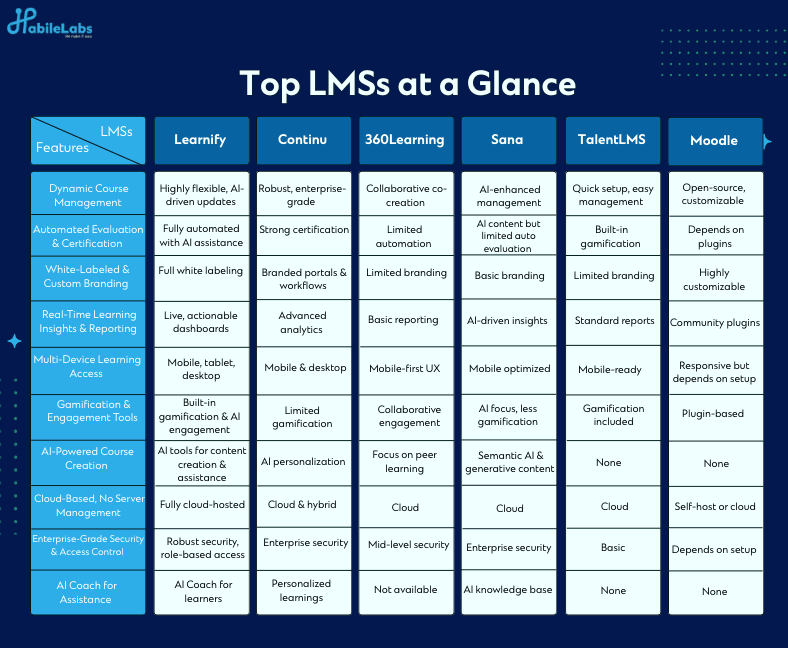
Below is a detailed comparison of the top-performing LMS of 2025, highlighting their standout features, strengths, and suitability for different organizational needs.
Conclusion: Choosing the Right LMS for Your Organization
Selecting an LMS isn't just about features, it’s about alignment with your business goals. What works for a global enterprise may not suit a growing startup, and vice versa. From enterprise-ready platforms like Continu to AI-driven innovation from Sana to open-source flexibility with Moodle, each LMS offers strengths that shine under different conditions.
But what if you're looking for an LMS solution that blends the flexibility of modern design, the power of AI, and enterprise-grade features without the bloat or cost? That’s where Learnify by Habilelabs stands out. Whether you’re scaling onboarding, delivering compliance training, or building leadership academies, the right LMS empowers your people and your business to grow.