





Beyond the Ticket Queue: Why Public Sector IT Needs AI-Powered ITSM
ByDishank Sharma

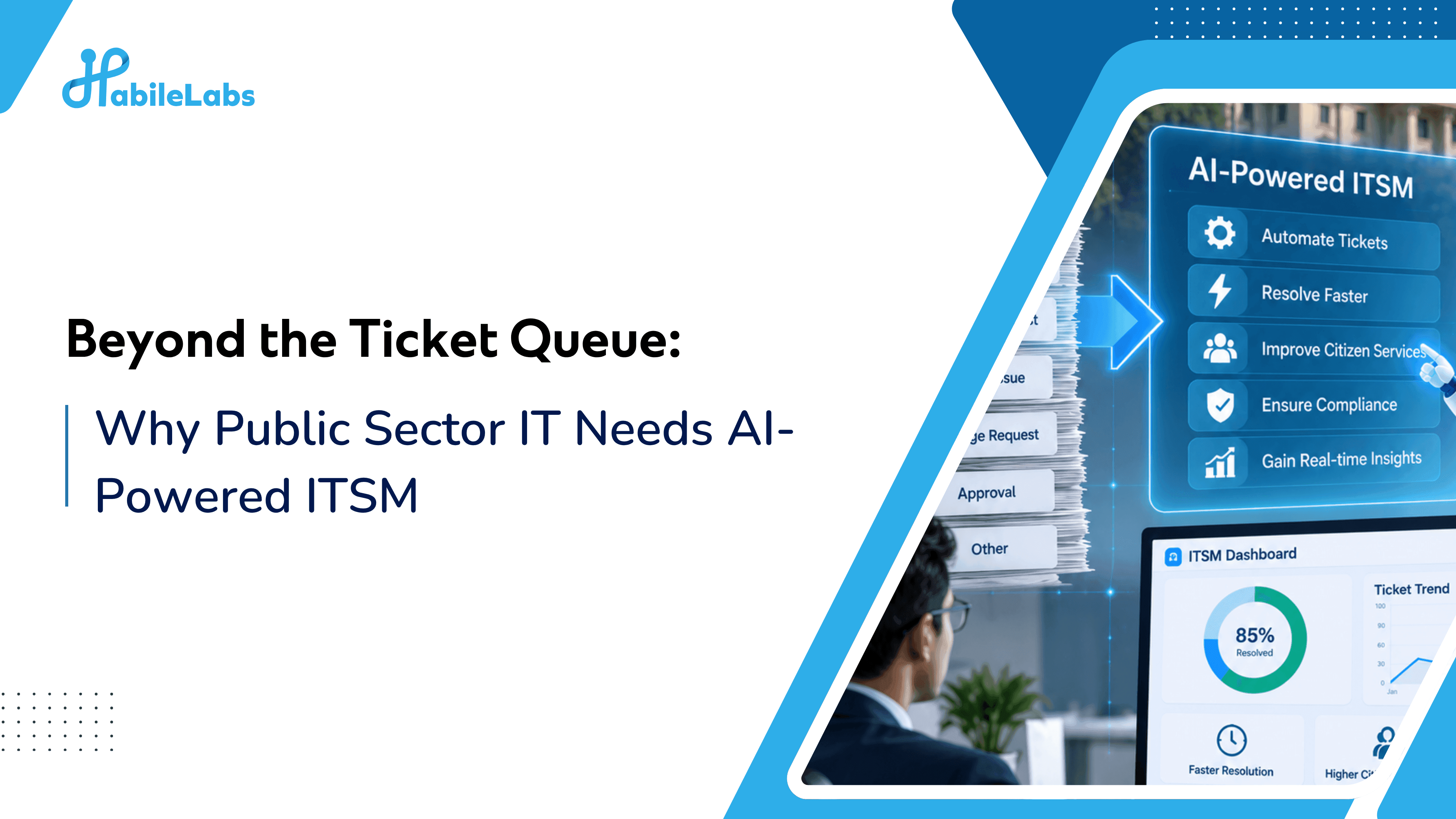
Every government IT leader knows the pattern. An employee’s VPN drops. A new hire needs system access before their start date. A password gets locked at 8am on a Monday. Each of these becomes a ticket, the ticket joins a queue, and a person has to pick it up, research it, and resolve it, often for a problem that has been solved a hundred times before.
Public sector IT teams operate under a particular kind of pressure: strict compliance requirements, security clearances on data and infrastructure, tight budgets, and workforces that expect the same responsiveness they get from consumer apps. Traditional ITSM platforms were built to track this work well. They were not built to do it.
That gap, between tracking work and actually resolving it, is where the next generation of IT service management has to go.
What Today’s ITSM Platforms Do Well (and Where They Stop)?
Modern platforms, like ServiceNow and Salesforce’s Public Sector ITSM foundation, etc. are genuinely strong at the fundamentals: incident management, problem management, change management, asset tracking, and SLA monitoring. These are mature, reliable capabilities, and any government agency modernizing its IT operations should expect them as table stakes.
But six gaps consistently show up once agencies push past the basics:
-
Knowledge sits still. Articles exist, but nothing executes the fix described in them. A human still has to read the steps and carry them out manually.
-
Incidents are handled, not prevented. Detection happens after something breaks, not before.
-
Access management is reactive. Permissions get granted and revoked manually, which means they go stale, a real security exposure in government environments.
-
Systems don’t talk to each other. Coordinating a fix across GitHub, Azure AD, VPN infrastructure, and other tools still requires multiple people and multiple tickets.
-
Problem management looks backward. Patterns only get noticed after they’ve caused repeated incidents, not before.
-
Self-service stops at information. Portals can show an employee an article, but they can’t actually finish the job for them.
None of this is a knock on the platforms themselves, it’s simply the boundary of what ticket-centric ITSM was designed to do.
A Different Starting Principle: Knowledge First, Action Second, Incident Last
The shift we’ve built our AI-Powered ITSM Accelerator around is a simple reordering of priorities: the goal is not to create incidents, it’s to avoid unnecessary ones.
Instead of an employee’s request immediately becoming a ticket, an Agentforce-powered AI agent takes the first pass:
-
The employee raises a request, in plain language, wherever they already work, Slack, Teams, or a web portal.
-
The agent searches the knowledge base for a relevant, executable fix.
-
If one exists, it triggers the automated action itself.
-
The employee gets confirmation that the issue is resolved.
-
Only if the issue can’t be resolved automatically does it become an incident, and by then, it arrives at a human agent with full context already attached.
This is a meaningfully different shape of service desk. Most requests never need a person at all.
What This Looks Like in Practice?
Three scenarios show how this plays out for common, and costly, public sector IT requests:
A locked account. Instead of waiting in a ticket queue, an employee tells the agent their Salesforce account is locked. The agent retrieves the unlock procedure, triggers the reset, and confirms resolution, with escalation to L2 support only if something goes wrong.
A VPN outage. The agent runs guided troubleshooting and checks service health directly. If multiple employees are affected at once, it doesn’t just log separate tickets, it recognizes the pattern, opens a major incident, and triggers the incident commander workflow automatically.
Onboarding access. When a hiring manager requests GitHub access for a new employee, the agent validates the request against onboarding policy, routes it through automated approval, provisions access through system integration, and notifies the employee, with a full audit trail generated along the way, at no extra effort.
The highest-impact example is role change automation: when HR updates an employee’s role, say, a promotion, the agent detects the change, checks it against the access control matrix, removes obsolete permissions, assigns the correct new ones, updates security groups, and notifies the employee. No ticket. No manual review queue. And critically for public sector compliance requirements, no stale access sitting around as a security risk. For agencies managing large-scale reorganizations, this alone can eliminate hundreds of manual access-change tickets.
Why This Matters More in Government Than Anywhere Else?
Private-sector IT teams care about efficiency. Public sector teams have to care about that and about auditability, data residency, and compliance frameworks like FedRAMP High, DoD IL4, and ITAR. An AI-driven service desk that can’t produce a clean audit trail, or that runs on infrastructure not built for government data, isn’t viable, no matter how much time it saves.
That’s why this isn’t a bolt-on chatbot. It’s built on Salesforce’s Government Cloud Plus foundation, with policy-based validation and full auditability engineered into every automated action, not layered on afterward.
The Employee Experience Side of the Equation
It’s easy to frame ITSM modernization purely as an operational efficiency story, but the employee experience impact is just as real. Research consistently shows the service desk is one of the single biggest drivers of overall IT satisfaction inside an organization. Agencies running AI-first resolution see average queue times drop under two minutes, with satisfaction rates climbing accordingly, because employees get consistent, instant support across channels and time zones, instead of waiting behind whoever filed a ticket first.
Where This Is Headed
This is a starting point, not an endpoint. The roadmap ahead includes automatic notifications when incidents resolve, auto-generated knowledge articles from resolved problems (so the system gets smarter with every ticket it does handle), multi-language support for agencies serving diverse regional workforces, and predictive recommendations for where employees may need additional training, flagged from request patterns before a formal need even surfaces.
The Takeaway
Public sector agencies don’t need another system to log what went wrong. They need IT operations that catch problems before employees notice them, resolve routine requests without a queue, and do all of it inside a compliance framework built for government from the ground up. That’s the shift from ITSM as a record-keeping system to ITSM as an active, autonomous part of the IT operation itself.
Interested in seeing what AI-powered ITSM modernization could look like for your agency? Get in touch with our AI Strategy & Consulting team to discuss a walkthrough tailored to your current Salesforce environment.