
Generative AI
Generative AI solutions for enterprises, built for production
Generative AI is AI that creates new content, such as text, summaries, answers and code, using large language models. HabileLabs designs and deploys domain-specific, secure GenAI on your own data, from intelligent chatbots and AI copilots to automated internal processes, with projects delivered in healthcare, BFSI and logistics.
- AWS AI Services Competency
- GenAI Partner of the Year, SoftwareOne
- Amazon Bedrock and SageMaker
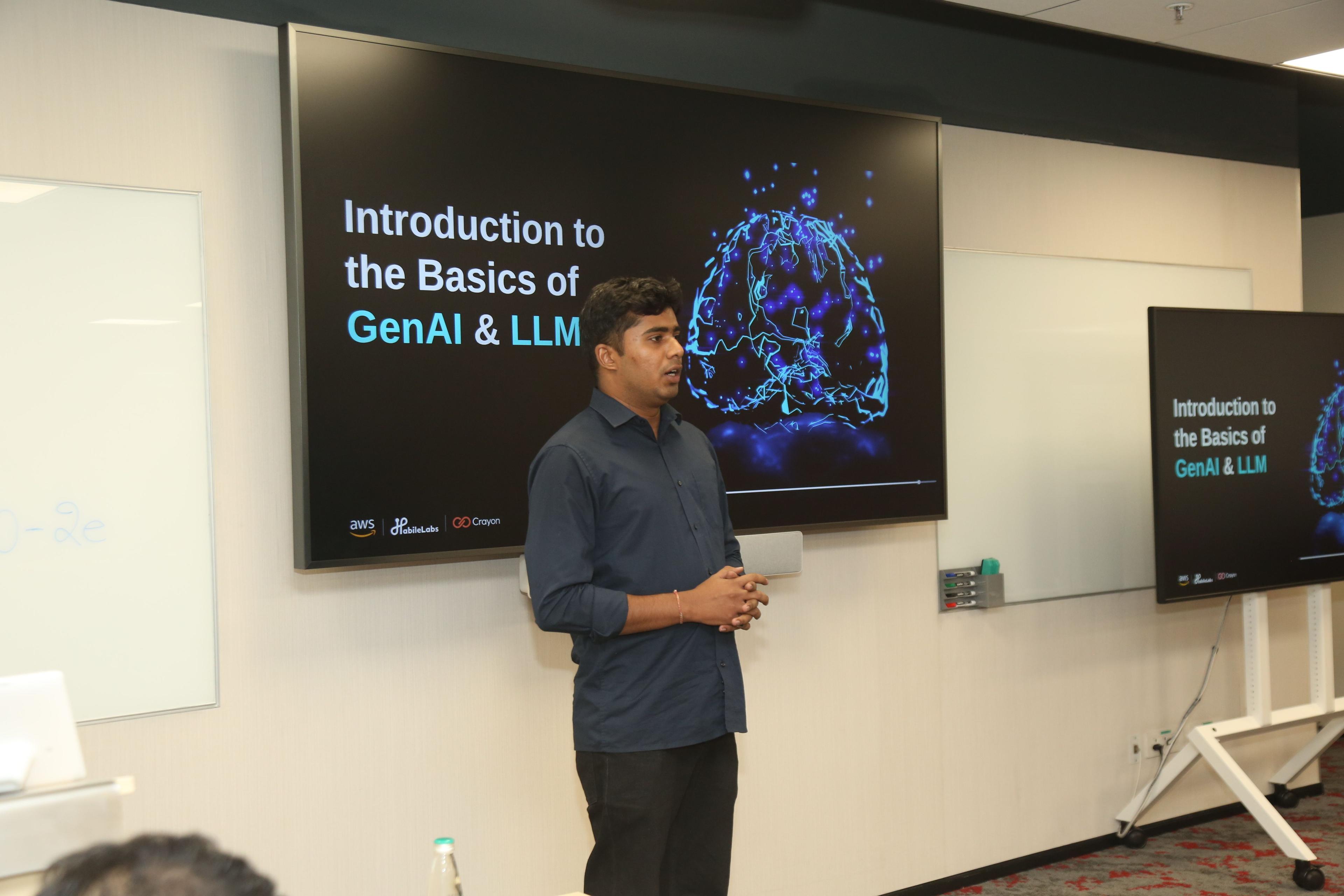
Partners for generative AI
Three AI partner programmes behind our generative AI work.
- 3AI partner programmes
- 4GenAI service lines
- 30%Shorter iSEEit deal cycles
What generative AI is good at
Where generative AI earns its place in a business
Generative AI does best where people spend hours reading, writing and searching. These are the jobs we see it do well, with an example of each from our case studies and products.
Summarizing long documents
Condense applications, contracts and reports into the facts a reviewer needs. For Aavas Financiers, Amazon Bedrock summarizes loan applications and supporting documents inside the DMS, so loan officers see key information quickly.
Answering questions from your own content
Retrieval-augmented generation grounds answers in your documents and systems. Ozoo.ai, HabileLabs' no-code AI agent, answers only from the content you give it and shows its sources.
Extracting key points
Pull decision-makers, risks and terms out of long documents. For iSEEit, Amazon Bedrock extracts key points from long documents such as proposals and contracts.
Writing reports and personalized messages
Draft stage reports, deal summaries and outreach from the data you already hold. iSEEit's platform now produces detailed stage reports, deal summaries and personalized messaging for sellers.
Enriching media and content
Generate captions, hashtags and descriptions that make content easier to find. Memorizz generates them for event photos and videos with Amazon Bedrock.
More examples by team and industry: AI use cases.
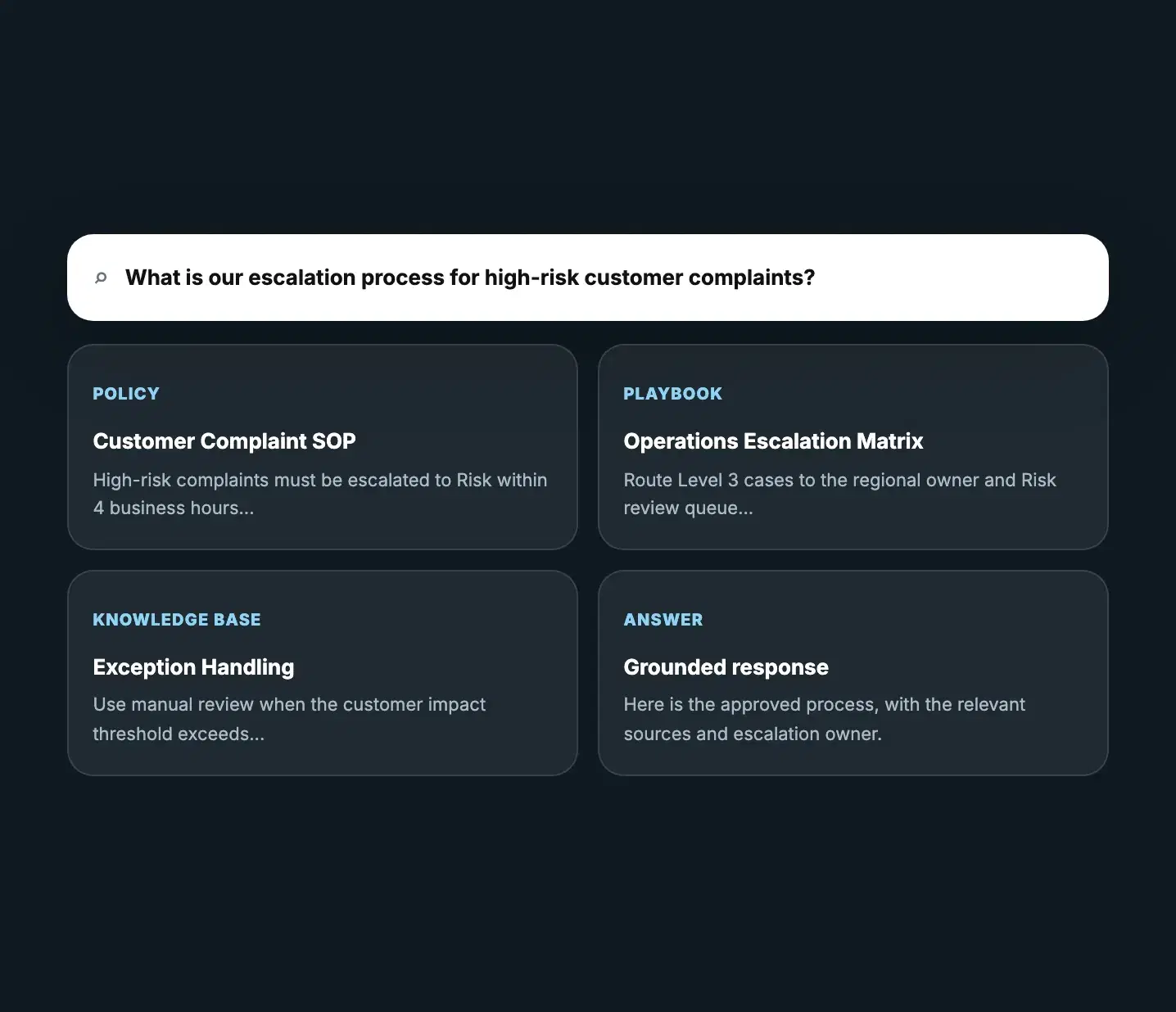
Generative AI services
Generative AI services, from first use case to production
Start with consulting, build an application, tune a model or automate documents. Each service has its own page with scope, process and client results.
GenAI consulting
Decide which GenAI use cases are worth building, then get a roadmap with clear KPIs, an architecture and a validated proof of concept.
GenAI consultingGenAI development
Models such as GPT, Claude and Mistral built into enterprise web and mobile apps, workflows and systems, with the data pipelines and integrations around them.
GenAI developmentLLM development
Large language models such as GPT, Claude and Cohere, fine-tuned to your domain, grounded in your data with RAG and run with monitoring and governance.
LLM developmentGenAI document processing
OCR, NLP and large language models that extract, classify, search and summarize documents, built into your ERP and CRM, on AWS, Azure or on-premises.
Document processingEnd-to-end GenAI delivery
One team from discovery and proof of concept to a minimum viable product and platform support at scale, built to run securely in production.
Generative AI servicesAgentic AI
When the application should act in your systems as well as answer, we build agents that plan, use tools and ask for approval where decisions matter.
Agentic AI
How it works
How a production GenAI application is put together
A working demo needs a model and a prompt. An application people rely on every day also needs retrieval, guardrails, evaluation and operations. Here is what each part does and what we use for it.
Retrieval
Ground every answer in your content
Retrieval-augmented generation (RAG) finds the passages in your documents and records that answer a question and passes them to the model with it, so the answer comes from your data and can cite its source.
What we use
- Amazon Bedrock Knowledge Bases
- Amazon Kendra
- Azure AI Search
- Elasticsearch
- Pinecone
- Weaviate
How we help
We build RAG pipelines and knowledge systems over the systems you already use, such as Salesforce, SAP, Microsoft Dynamics 365, SharePoint and Zoho.
Models
Choose the right model for each task
Models differ in quality, speed, cost and where they can run. Many applications use more than one: a capable model for reasoning and a faster, cheaper one for extraction and classification.
What we use
- GPT
- Claude
- Mistral
- Cohere
- Amazon Bedrock
- Azure OpenAI
How we help
We select models, fine-tune them where it pays off, and run them on the platform your data and compliance needs call for. HabileLabs is an OpenAI Select Partner and a Registered Partner in Anthropic's Claude Partner Network.
Guardrails
Control what goes in and what comes out
Guardrails keep sensitive data away from the model and check answers before they reach users. Role-based access means people only get answers from content they are allowed to see.
What we use
- Approved data sources
- Role-based access
- Data anonymization
- Audit logs
How we help
Governance is designed in from the start: data anonymization, security controls, bias mitigation and explainability, with human review where decisions matter.
Evaluation
Test the answers before users do
A set of real questions with known-good answers shows how accurate and well grounded the application is, and catches regressions when a prompt, model or data source changes.
What we use
- Accuracy
- Grounding
- Fallback behavior
How we help
Before launch we test against your own data, including permissions, privacy controls, guardrails and fallback behavior.
Operations
Watch quality, latency and cost after launch
Documents change, usage grows and models are updated. Monitoring tracks answer quality, latency, token use and cost, so drift is caught before users notice it.
What we use
- LLMOps
- Amazon SageMaker
- Azure ML
- Cost tracking
How we help
After launch we keep tracking quality, latency, token use and cost, and support continues under SLAs that include monitoring for accuracy, drift and cost.
When the application needs to act
If the next step after an answer is updating a record or starting a workflow, the same parts carry over into an agent, with planning, tools and human approval added.
Models and platforms
Platforms we build generative AI on
We work across the major model providers and clouds, and choose per use case: where your data lives, what it must comply with and what it will cost to run.
Amazon Bedrock
Foundation models from Amazon and other providers, such as Anthropic and Meta, through one managed API. Behind our GenAI work for iSEEit and Aavas Financiers, and Ozoo.ai.
AWS AI servicesOpenAI
GPT models turned into working systems, with your data, integrations, permissions and monitoring around them. HabileLabs is an OpenAI Select Partner.
OpenAI servicesAnthropic Claude
Claude models for reasoning, enterprise knowledge and code, used directly or through Amazon Bedrock. HabileLabs is a Registered Partner in Anthropic's Claude Partner Network.
Claude Partner NetworkAzure OpenAI
OpenAI models hosted in Microsoft Azure, for teams whose data and identity already live there. HabileLabs is a Microsoft Solutions Partner for Azure Data & AI.
Microsoft Azure servicesAmazon SageMaker
Custom models trained and deployed on your data, next to foundation models. iSEEit uses both, with Amazon SageMaker models and Amazon Bedrock in one platform.
Custom AI developmentGoogle Cloud
Enterprise AI and the Gemini ecosystem on Google Cloud, with AI application engineering focused on production use cases. HabileLabs is a Google Cloud Partner.
Google Cloud
Client results
Generative AI client results
 Amazon Bedrock · SageMaker30%shorter deal cycles with an AI-infused Salesforce CRMiSEEit →
 NBFC · Amazon BedrockAmazon Bedrocksummaries of loan applications inside the DMSAavas Financiers →
 IT services · Amazon BedrockClaude on Bedrockcontext-aware support answers from Ozoo.ai, with reduced resolution timesHabileSoft India →
Recognition
SoftwareOne's GenAI Partner of the Year
SoftwareOne named HabileLabs its GenAI Partner of the Year, recognizing work across generative AI, AI consulting, enterprise AI solutions and AI implementation.
More on our credentials and delivery approach: why HabileLabs for AI.
Also held
 AWS AI Services Competency · awarded 12 September 2025
 OpenAI Select Partner
 Claude Partner Network · Registered Partner

“The real opportunity with AI is not simply adopting new technology. It is identifying where AI can create measurable business value and building solutions that can operate reliably at scale.”
Generative AI FAQs
Is generative AI right for your business?
Answers to the questions we hear most from teams weighing up GenAI.
Generative AI is AI that creates new content, such as text, summaries, answers, images or code, using foundation models such as large language models. In a business it is usually connected to company data, so it can answer questions, draft documents and summarize records in context.
Generative AI produces content when it is asked, and a person decides what to do with it. Agentic AI uses the same models but also plans steps, calls tools and systems, and acts toward a goal, usually with human approval for decisions that matter. Many systems use both: generative AI to read and write, agents to act on the result.
Start with retrieval-augmented generation (RAG) when answers must come from documents that change, because the model reads the current content at question time and can cite it. Fine-tuning helps when a model needs a domain's language, format or tone. Many production systems use RAG and add fine-tuning only where it measurably helps.
We build on Amazon Bedrock, OpenAI, Anthropic Claude and Azure OpenAI, with models such as GPT, Claude, Mistral and Cohere, and Amazon SageMaker for custom models. HabileLabs holds the AWS AI Services Competency, is an OpenAI Select Partner and is a Registered Partner in Anthropic's Claude Partner Network.
Yes. GenAI can run on-premises, in the cloud or in a hybrid setup, on AWS or Azure, depending on your data and compliance needs.
Answers are grounded in approved data and checked by guardrails before they reach users. In Ozoo.ai, drawing on multiple data sources with Claude models reduced hallucinations and bias.
Governance, data privacy and compliance are designed in from the start, with data anonymization and security configurations that protect sensitive information.
BFSI, healthcare, EdTech, retail and logistics. Examples include loan application summaries for Aavas Financiers on Amazon Bedrock, and sales reports and deal summaries for iSEEit on Amazon Bedrock and Amazon SageMaker.