
Legacy modernization
Second Run: legacy modernization proven to match the old system before you switch
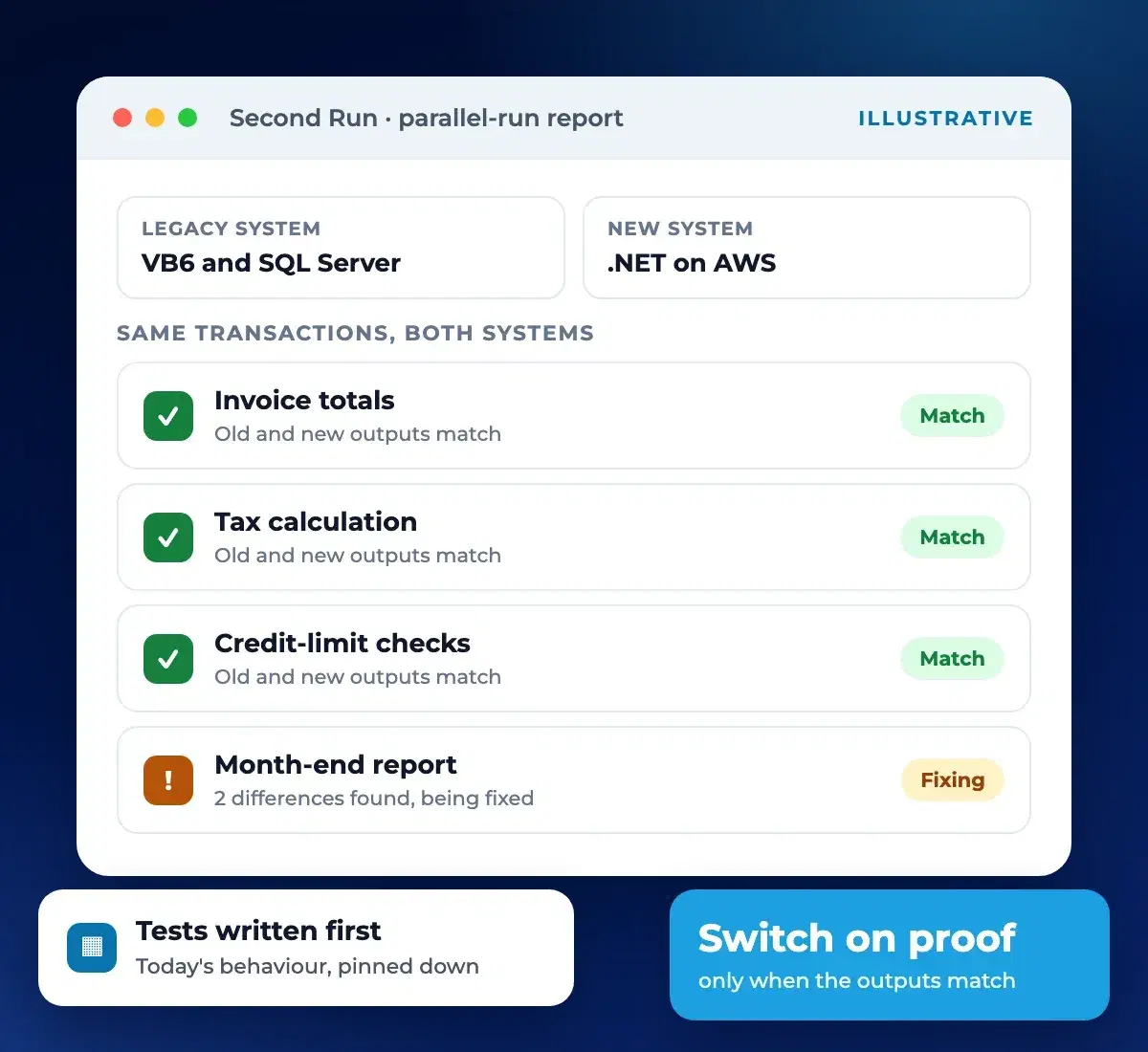
Second Run is HabileLabs' legacy modernization service. AI agents do most of the code conversion. Our engineers write the tests first, run the old and new systems side by side on the same transactions, and sign off.
A free Legacy Scan ends with a fixed quote, and you pay the final milestone only when the outputs match.
- Free Legacy Scan with a fixed quote
- One module at a time, while the old system keeps running
- Switch only when old and new outputs match
What we modernize
The legacy systems big modernization programmes skip
Most AI modernization offers target mainframes and multi-million-dollar estates. Second Run is built for the business applications mid-sized companies actually run.
.NET Framework and SQL Server
Move to modern .NET and PostgreSQL on AWS, with Windows and SQL Server licence costs in view.
Oracle Forms
Rebuild as a web application with modern APIs, planned around Oracle's support timelines.
VB6, Access and classic ASP
Desktop and early-web applications rebuilt as secure web applications.
Legacy PHP applications
Unsupported PHP versions and home-grown CMSs brought up to date, or rebuilt on a new stack.
Salesforce org clean-up
Workflow Rules and Process Builder moved to Flow, and Apex refactored, without breaking what your teams use.
Salesforce servicesJava and older .NET versions
Version upgrades and framework moves for applications that still run but are falling behind.
Mainframe modernization is available with specialist partners. Moving infrastructure rather than code? See cloud modernization.
The method
One module at a time, while the old system keeps running
Big-bang rewrites are where modernization projects most often fail. Second Run moves in small steps, each one proven before the next.
Legacy Scan
Ten working days: code inventory, business rules, risks, target architecture and a fixed quote. Free.
Module One
One bounded module rebuilt and proven first, so you see the method before you commit to the rest.
Tests first
Today's behaviour is pinned down in automated tests before any code changes.
Parallel run
Old and new systems process the same transactions until the outputs match.
Cutover and run
Switch when you're ready, then we run it on AWS or hand it to your team.
Agent-built, engineer-signed
Who does what in a Second Run project
AI agents make conversion fast and affordable. Engineers make it safe.
AI agents
- Map the code, dependencies and business rules
- Convert code module by module
- Draft tests from today's behaviour
- Flag differences found in the parallel run
Engineers sign off every module
HabileLabs engineers
- Confirm the business rules with your team
- Review and sign every change
- Plan and rehearse the data migration
- Decide the switch with you
We use AWS Transform and other AI coding agents where they fit the stack. Data migration always gets its own plan and rehearsal.
Fixed quote, paid on proof
You pay the final milestone when the outputs match
After the free Legacy Scan you get a fixed quote for the whole job, not an hourly estimate.
A binding fixed quote at the end of the scan
Module One first, credited to the full job
The final milestone paid only when the parallel run shows the new system matches the old one on the transactions we agreed
Help applying for any AWS programme funding you qualify for
Why HabileLabs
An AWS Advanced Tier Services Partner with the AWS AI Services Competency
- 50+AWS certifications
- 200+AWS customer launches
- 2AWS competencies
Legacy modernization FAQs
Legacy modernization with AI agents: common questions
What teams ask before they touch a system the business depends on.
It is modernizing old software with AI agents that read, map and convert the code, while engineers write the tests, check every change and prove the new system behaves like the old one. HabileLabs calls its approach Second Run.
No. Agents do most of the conversion, but hidden business rules, data migration and cutover need engineers. We check every change against tests built from today's system.
With a parallel run: the old and new systems process the same transactions and we compare the outputs. You switch only when they match on the transactions we agreed.
Yes. We move one module at a time and the old system keeps running until you decide to switch.
Ten working days of analysis: an inventory of your code, a sample of its business rules, a risk map, a target architecture and a binding fixed quote.
Data migration gets its own plan and rehearsal, agreed during the scan.
Yes, together with specialist partners. Talk to us about your estate.