
Agentic AI services
Agentic AI services: agents that plan, act and check their work
Agentic AI is AI that works toward a goal instead of answering a single prompt: it plans the steps, uses tools and data to carry them out, checks the result and asks a person before decisions that matter. HabileLabs builds agentic AI on Amazon Bedrock, OpenAI and Anthropic Claude, wired into the systems you already run, with guardrails, human approval and evaluation designed in.
- AWS AI Services Competency
- Claude Partner Network
- OpenAI Select Partner
Agentic AI in production
What governed AI agents changed for iSEEit
42% → 85%
Opportunities with complete MEDDPICC data, within 6 months
92%
Agreement between agent MEDDPICC assessments and expert human review
~3 hrs/week
Of manual data entry removed per seller
32%
Lower inference cost per processed deal
Figures from the iSEEit agentic AI case study: a supervisor-and-specialist agent system on Amazon Bedrock, with Anthropic Claude models as the reasoning engine, designed and delivered by HabileLabs.
What is agentic AI?
What makes an AI system agentic
An AI system is agentic when it is given an outcome to reach and works out, then carries out, the steps to get there. Six properties make that possible, and each one has to be designed, tested and governed.
A goal
The agent is given an outcome, such as an up-to-date deal record or a resolved support case, and keeps working until it gets there or reaches a limit.
Planning
It breaks the goal into steps, chooses the order and changes the plan when a step fails. Larger systems split the work between a supervisor agent and specialist agents.
Tool use
It acts through tools you expose to it: APIs, databases, search, your CRM or ticketing system. Each tool carries only the permissions the task needs.
Memory and knowledge
It keeps track of what it has done in a run and retrieves the facts it needs from your documents and records, so its decisions rest on your data.
Guardrails and human approval
Rules limit what it may say and do. Actions that change records, spend money or reach a customer can wait for a person to approve them.
Evaluation
Its outputs are scored against known-good answers before a prompt, model or tool change goes live, and every action is logged so decisions can be traced.
Further reading on the HabileLabs blog: AI agents vs agentic AI and from generative to agentic AI.
Agentic AI vs generative AI
Chatbot, copilot or agent: what is the difference?
All three can run on the same generative AI models. What differs is who acts on the output. With a chatbot or a copilot, a person reads what the model produced and decides what happens next. With an agent, the system takes those steps itself, inside limits you set.
Chatbots and copilots: a person acts
- Answer a question or draft content when someone asks
- Work inside one conversation or one application
- A person reads the output and takes the next step
- Mistakes reach a person before they reach a system
- Suited to answers, drafts, summaries and search
Who acts on the output?
Agents: the AI acts, within limits
- Take a goal and work out the steps to reach it
- Call your APIs, databases and business systems
- Update records and trigger workflows themselves
- Ask for approval before actions that matter
- Suited to multi-step work that repeats every day
Most production systems combine both. See generative AI for the model layer, conversational AI for chat and voice assistants, and AI agent development for how we deliver agents.
Agents we build
Where we put AI agents to work
Each example is a client project or a HabileLabs product. The patterns carry across industries: a goal, the tools to reach it and a person where the decision matters.
Sales qualification agents
Specialist agents extract signals from call transcripts, emails and meeting notes, assess MEDDPICC qualification, detect deal risk and suggest the next best action. Built for iSEEit on Amazon Bedrock.
iSEEit case studyAgents inside Salesforce
Agentforce agents that create records, update statuses and qualify leads from plain English instructions, with every instruction checked against role-based access before it runs. Delivered for Unaric.
Agentforce servicesCustomer support agents
ProGPT, HabileLabs' no-code AI agent, answers only from your own content, shows its sources and runs on your website, in an app, or in Microsoft Teams and Slack.
ProGPTVoice and chat agents
Ozoo.ai voice and chat agents talk to customers in Hindi, English and 12+ Indian languages across WhatsApp, web, app and SMS, alongside role-based AI teammates for IT, HR and compliance work.
Ozoo.aiAgents in software delivery
Kiro, AWS's agentic AI development environment, rolled out with workshops, team champions and a cost dashboard. SAS Tech Studio is scaling it from 24 to 63 active developers.
SAS Tech Studio case studyCustom multi-agent systems
A supervisor agent that delegates to specialist agents, run as stateful, retryable workflows with least-privilege tools, approval rules and a full audit trail, designed around your process.
AI agent development
How we build agents
How HabileLabs builds an agent, step by step
Six practices we apply when we build agents. Under each one is what it looked like in the multi-agent system we built for iSEEit on Amazon Bedrock.
Context-aware automation
Ground the agent in the evidence
Agents read unstructured signals such as call transcripts, emails and meeting notes, and act on them in context. Retrieval brings in the facts they need from your own documents and records.
Built with
- Amazon Bedrock Knowledge Bases
- Amazon OpenSearch Serverless
- Amazon Titan Text Embeddings
At iSEEit
Signals are extracted from call transcripts, emails and meeting notes, where MEDDPICC evidence had been scattered while sellers kept records by hand.
Multi-step reasoning in one workflow
Split the work between a supervisor and specialists
A supervisor agent delegates to specialist agents, coordinated as stateful, retryable workflows. Model routing gives multi-step reasoning to a higher-capability model and extraction to a faster one.
Built with
- Amazon Bedrock Agents
- AWS Step Functions
- AWS Lambda
- Anthropic Claude
At iSEEit
Specialist agents handle signal extraction, MEDDPICC qualification, deal risk detection and next-best-action generation.
Secure and compliant by design
Limit what the agent can touch, and log every action
Tenant isolation, encryption, guardrails and least-privilege tools keep each agent inside its job. An approval ledger records what each agent proposed and who accepted it.
Built with
- Amazon Bedrock Guardrails
- AWS IAM
- AWS KMS
- AWS Secrets Manager
- AWS CloudTrail
At iSEEit
Analysis runs automatically, while write-back to the CRM needs human approval or a tenant-configured confidence threshold. 100% of autonomous actions were logged with source citations and a complete approval trail.
Continuous learning and optimization
Evaluate before every change
A golden-dataset evaluation harness scores agent output before any prompt, model or tool change is promoted to production.
Scored on
- Qualification accuracy
- Grounding
- Action appropriateness
At iSEEit
Agent-generated MEDDPICC assessments achieved 92% agreement with expert human review on the evaluation dataset.
Omnichannel experience
Connect the agent where people already work
Modular agents connect through APIs and deploy across web, mobile and enterprise systems, so their results land in the tools teams already use.
Built with
- Amazon API Gateway
- Amazon EventBridge
- Amazon SQS
- Amazon ECS on AWS Fargate
At iSEEit
Weekly active usage of qualification features increased by 47% following launch.
Operational efficiency
Measure the time and the cost
Model routing, prompt caching and token budgets send each task to the smallest model that can do it, and per-tenant cost attribution shows where the spend goes.
Techniques
- Model routing
- Prompt caching
- Context compaction
- Token budgets
At iSEEit
Automated signal extraction and CRM updates removed approximately 3 hours per seller per week of manual data entry, and inference cost per processed deal fell by 32%.
Ready to scope your first agent?
We begin with one workflow and a clear path to production, then build, evaluate and roll out the agent with your team.
Models, frameworks and platforms
What we build agents with
The models, agent frameworks and platforms behind our agent builds. We pick per task, and model routing sends each step to the smallest model that can do it.
Foundation models
Reasoning and language models, chosen per step.
Agent frameworks
Orchestration for single-agent and multi-agent systems.
Agents on AWS
The managed services behind the iSEEit agents.
Retrieval and memory
Grounding in your documents and records.
Guardrails and audit
Limits, permissions and a full trail of every action.
Agents in business platforms
Agents inside the CRM and workplace tools you already use.
Platform pages: AWS AI services, OpenAI and Anthropic Claude.
Client results
Agentic AI in client work
 Agentic AI · Amazon Bedrock42% → 85%MEDDPICC coverage within 6 months, with governed multi-agent AIiSEEit →
 Salesforce · AgentforceAgentforcerecord creation, status updates and lead qualification from plain EnglishUnaric →
 AWS · Kiro24 → 63developers on Kiro, AWS's agentic AI development environment, targeted to grow from 24 to 63 by December 2026SAS Tech Studio →
Agentic AI practice
Who leads agentic AI at HabileLabs
Nikhil Khandelwal, Vice President, AI Engineering, leads the Agentic AI practice, partnering with CIOs and CTOs to design and deliver production-grade AI systems. He specializes in generative AI, agentic AI, RAG systems and scalable backend architectures.
More on our credentials and delivery approach: why HabileLabs for AI.
Partner credentials
 AWS AI Services Competency · Agentic AI and Generative AI Consulting Services
 Claude Partner Network · Registered Partner
 OpenAI Select Partner


“Businesses are moving beyond experimenting with Generative AI and looking at how AI can actually reason, act, and automate meaningful parts of their operations.”
Events
Agentic AI, discussed without the hype
Recent sessions where the HabileLabs team worked through agentic AI with CXOs and technology leaders.
14 Oct 2026 · New Delhi
Agentic AI Without the Hype, Delhi NCR
The Delhi NCR edition of the roundtable with SoftwareOne and AWS, for technology leaders at Eros Hotel, New Delhi.
Event details7 Oct 2026 · Jaipur
Agentic AI Without the Hype, Jaipur
A closed-door roundtable with SoftwareOne and AWS at Radisson, Jaipur City Center, with Ankit Dhir, Shankar Morwal and Shahid Khan.
Event details11 Sep 2026 · Pune
C-Suite Social: Agentic AI Night
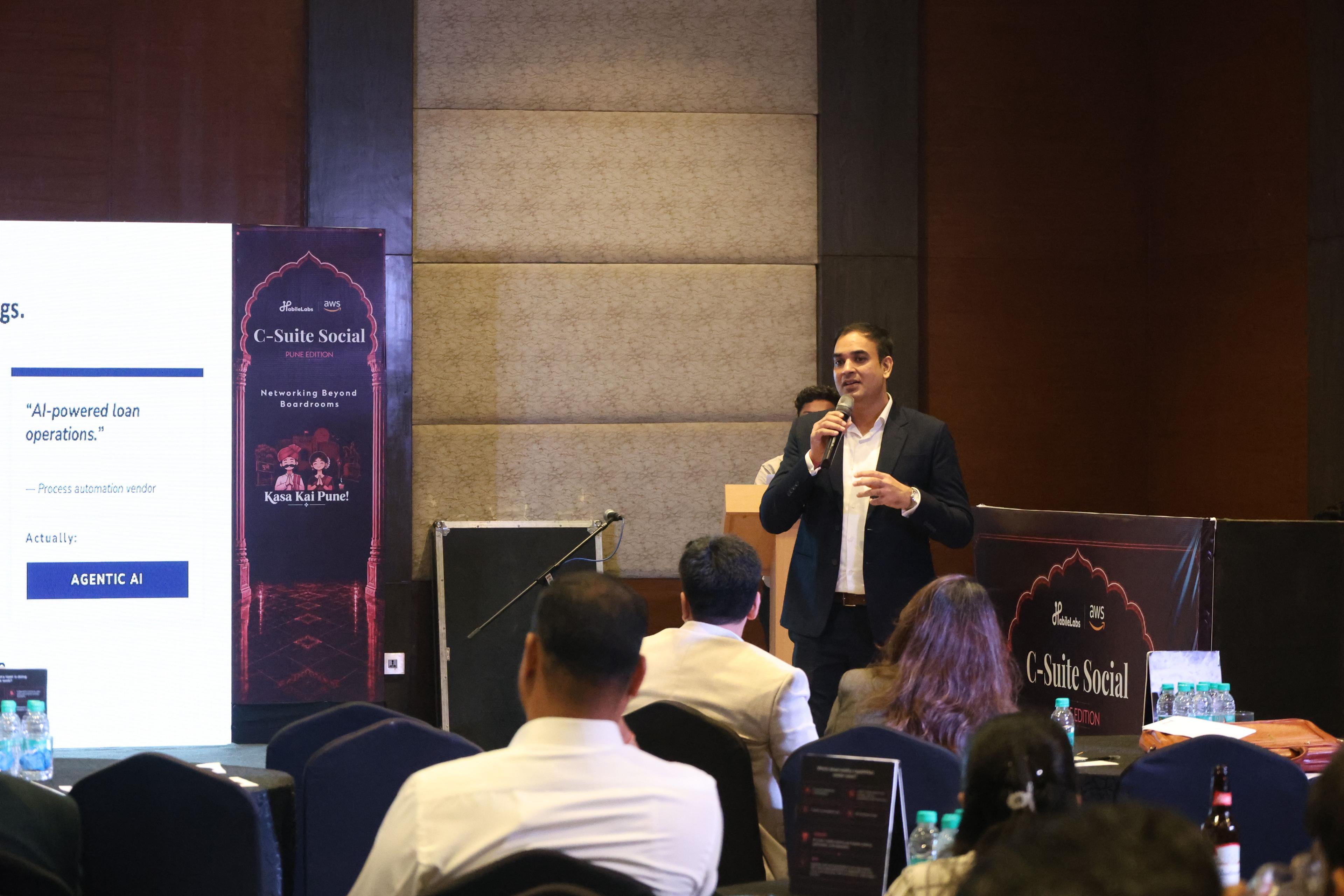
A CXO networking evening at Radisson Blu Pune Hinjawadi, themed on agentic AI, with speakers including Nikhil Khandelwal.
Event details
Agentic AI FAQs
Agentic AI questions, answered
What agentic AI is, how it differs from generative AI, and how we build agents that are safe to run.
Agentic AI is AI that works toward a goal instead of answering a single prompt. An agentic system plans the steps, uses tools such as APIs, databases and business applications to carry them out, checks the results and asks a person to approve decisions that matter. It is usually built from one or more AI agents running on large language models.
Generative AI creates content, such as text, summaries, answers or code, when it is asked. Agentic AI uses generative models as its reasoning engine and adds planning, tool use and action toward an outcome. A model that drafts a follow-up email is generative AI. A system that reads the deal history, drafts the email, updates the CRM and asks for approval before sending is agentic AI.
Not quite. An AI agent is one piece of software that carries out tasks with some autonomy. Agentic AI describes the wider approach, where one or more agents pursue a goal with planning, tools, memory, guardrails and evaluation. Production systems often have several agents, such as a supervisor that delegates to specialists.
Each agent gets least-privilege access to the tools it needs, guardrails on what it can say and do, and an approval step before actions that change records or reach customers. In the iSEEit build, analysis runs automatically while write-back to the CRM needs human approval or a tenant-configured confidence threshold, and 100% of autonomous actions were logged with source citations and a complete approval trail.
We measure an agent before and after release. Before release, a golden-dataset evaluation scores its outputs before any prompt, model or tool change is promoted to production. After release, we track the business result the agent was built for. At iSEEit, agent MEDDPICC assessments reached 92% agreement with expert human review on the evaluation dataset, and opportunities with complete MEDDPICC data rose from 42% to 85% within 6 months.
We build on Amazon Bedrock, OpenAI and Anthropic Claude, with models such as Claude, GPT-4, LLaMA, Mistral and Cohere and frameworks such as LangChain, AutoGen and CrewAI. Inside Salesforce we build with Agentforce. iSEEit's agents run on Amazon Bedrock with Anthropic Claude models.
Model routing, prompt caching and token budgets send each task to the smallest model that can do it, and token-budget ceilings per agent run cap what a single run can spend. At iSEEit this cut inference cost per processed deal by 32%.
Pick one workflow that repeats every day and has a clear owner. HabileLabs runs a free AI readiness assessment so you can plan before you commit to a build. On Anthropic Claude we also offer a 14-day pilot that starts with one practical workflow and a clear production path, and Agentforce deployments covering two or three use cases typically take four to eight weeks.
Next step
Which workflow should an agent run first?
Tell us what the work is, which systems it touches and where a person must stay in charge. We will tell you whether an agent is the right tool, and what it would take to run it safely.
- Free AI readiness assessment
- Human approval where decisions matter
- Evaluated before every change