Less manual work for your teams
AI agents take on data entry, summaries and reports. At iSEEit, governed agents on Amazon Bedrock save each seller about 3 hours of data entry every week.
For enterprises with AI ideas but no clear path to production: we pick the use cases worth funding, build them on AWS with security and governance in place, and measure what they change.
AWS Partner, Advanced Tier Services


AWS AI services are the managed services Amazon Web Services offers for building AI into products and operations: Amazon Bedrock for generative AI and agents, Amazon SageMaker for custom machine learning models, and task-specific services such as Amazon Rekognition and Amazon Comprehend. HabileLabs, an AWS Advanced Tier Services Partner with the AWS AI Services Competency, helps enterprises choose the use cases worth building, builds them on these services and runs them in production.
Enterprise AI projects usually stall for one of these reasons:
Each of these comes down to architecture, data or governance, which is the work we do before and around the model.
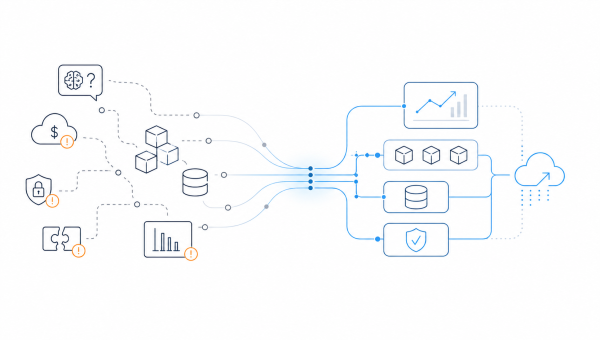
What our AI clients gain, and the AWS capability behind each.
AI agents take on data entry, summaries and reports. At iSEEit, governed agents on Amazon Bedrock save each seller about 3 hours of data entry every week.
Assistants on Amazon Bedrock answer support questions with context from your own content. HabileSoft India reduced resolution times with Ozoo.ai.
Models are called through your own AWS account with encryption, IAM access controls and VPC isolation, so customer data stays inside the boundary you set.
Model choice, right-sized compute and inference monitoring keep spend tied to usage, with running costs estimated before you commit to a deployment.
Managed services such as Amazon Bedrock and Amazon SageMaker handle the servers and scaling, so effort goes into the use case itself.
Monitoring for drift, accuracy and cost, plus feedback loops, keeps models useful as your data changes and newer AWS models become available.
From choosing the first use case to running models in production, with one team throughout.
We assess your data, infrastructure and goals, find the use cases with the clearest return and build a prioritized roadmap with ROI targets.
Applications on Amazon Bedrock's managed foundation models: document summaries, report generation, search over your own content and support assistants.
Agents that plan and carry out multi-step tasks in your systems, with guardrails and human review where decisions matter. iSEEit runs governed multi-agent AI on Amazon Bedrock.
Custom models trained, tuned and deployed on Amazon SageMaker when a foundation model is not the right fit for the task.
Data pipelines and warehouses that feed model training, analytics and real-time decisions, including streaming data with Amazon Kinesis.
Tracking of accuracy, drift, latency and cost in production, with regular tuning of models, prompts and infrastructure.
Four stages, with a business target agreed before any model is built.
We assess data readiness, infrastructure and goals, then rank candidate use cases by expected impact and effort.
We choose the model approach (foundation model, custom model or both) and design a secure architecture on AWS.
We build, test and deploy on managed AWS services, with access controls, logging and human review built in.
We track accuracy, drift and cost in production and tune the system as usage grows and AWS models change.
Client results on AWS
AWS AI services are Amazon Web Services' managed services for building and running AI. They include Amazon Bedrock for generative AI foundation models, Amazon SageMaker for training and deploying machine learning models, Amazon Rekognition for image and video analysis, Amazon Comprehend for text analysis, Amazon Lex for conversational interfaces and Amazon Polly for text-to-speech.
It is an AWS designation for partners whose AI delivery on customer work has passed an independent AWS audit; it cannot be self-assessed. HabileLabs was awarded it on 12 September 2025. Every AWS Competency also requires AWS Advanced Tier Services status, which HabileLabs holds.
Amazon Bedrock gives you ready-made foundation models from Amazon and other providers, such as Anthropic and Meta, through one managed API, so you build on a model instead of training one. Amazon SageMaker is for building, training and deploying your own machine learning models. Many systems use both, as iSEEit does for its sales reports and deal summaries.
Agentic AI means AI agents that plan and carry out multi-step tasks, calling tools and systems along the way, instead of answering one prompt at a time. On AWS, agents are usually built on Amazon Bedrock. iSEEit runs governed multi-agent AI on Amazon Bedrock that raised MEDDPICC coverage from 42% to 85% within 6 months.
It depends on model choice, how often the model is called, data volume and the AWS services used. With the right architecture, costs can be estimated and controlled before launch. HabileLabs runs a free AI readiness assessment so you can plan the investment before you commit to a deployment.
Yes, when it is set up that way. AWS provides encryption at rest and in transit, IAM access controls and VPC isolation, offers HIPAA-eligible services and publishes compliance reports such as SOC 2. HabileLabs adds governance, access rules and audit logging to meet your industry's specific requirements.
Yes. They connect to enterprise applications, databases and workflows through APIs, SDKs and AWS connectors, whether your systems run on-premises, in a hybrid setup or on AWS. We integrate AI into what you run today, so you do not need a disruptive migration first.
Banks and NBFCs use them for document processing, fraud detection and risk modeling. Healthcare organizations use them for clinical decision support and medical imaging analysis. SaaS companies add AI features to their products, and retailers build recommendation engines. Aavas Financiers, a housing finance company, summarizes loan applications with Amazon Bedrock.
Tell us the process you want to change. An AWS-certified architect will come back with candidate use cases, the data each one needs and a rough plan to production.