Attacks stopped before your app
AWS WAF managed and custom rules filter SQL injection, cross-site scripting and bot traffic at the edge. Wonder Finance has blocked over 12 million malicious requests this way.
For banks, NBFCs, hospitals and SaaS teams that cannot afford a breach or a long outage: we close the security gaps in your AWS setup and build a recovery plan you have tested before you need it.
AWS Partner, Advanced Tier Services



AWS security and disaster recovery services protect the applications and data you run on Amazon Web Services and restore them after a failure, attack or outage. HabileLabs, an AWS Advanced Tier Services Partner, closes gaps in identity, encryption, network protection and monitoring, then builds and tests a recovery plan around the recovery time and recovery point objectives (RTO and RPO) you set. We do this for banks, NBFCs, hospitals and SaaS companies.
Teams usually call us after an audit finding or an outage exposes one of these:
Each of these has a known fix on AWS. We find which ones apply to you, fix them in order of risk and test the recovery plan with your team.
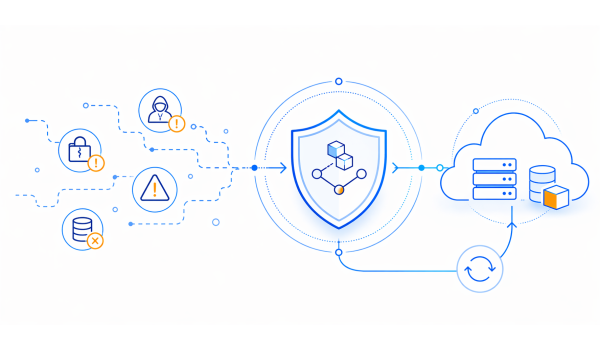
What our security and disaster recovery clients gain, and the AWS mechanism behind each.
AWS WAF managed and custom rules filter SQL injection, cross-site scripting and bot traffic at the edge. Wonder Finance has blocked over 12 million malicious requests this way.
Each system gets a recovery target and a setup built to meet it. iSEEit runs its Amazon RDS for PostgreSQL database with a 15-minute RTO.
Encryption at rest with AWS Key Management Service (AWS KMS) and in transit covers storage, backups and replicas, so customer records stay protected.
Least-privilege IAM roles and logged activity show who can reach which account and dataset, and give auditors the evidence they ask for.
Continuous monitoring with logs and alerts flags unusual activity, so your team can respond while an incident is still small.
Pilot light and warm standby keep a small copy running instead of a second full environment, so you pay for full capacity only where a system needs it.
One team covers both halves: keeping attackers and mistakes out, and getting you back online when something fails.
A review of your AWS accounts against the AWS Well-Architected security pillar: misconfigurations, open access, unencrypted data and missing logs, ranked by risk.
IAM roles, permission boundaries and sign-in controls set up so each person and service gets only the access it needs.
Encryption at rest with AWS KMS and in transit, key policies, and secure storage settings for Amazon S3 buckets, databases and backups.
Managed and custom AWS WAF rules against SQL injection, cross-site scripting and bots, tuned to your traffic. HabileLabs holds the AWS WAF Service Delivery validation.
Automated backups, cross-region replication and failover, using backup and restore, pilot light, warm standby or active-active, or AWS Elastic Disaster Recovery.
Security monitoring and alerts, scheduled recovery drills, and documentation your auditors and regulators can review.
Four stages. You see the risks and agree the recovery targets before anything changes.
We review your AWS environment, map critical systems and data, and list the security gaps and recovery risks we find.
We agree an RTO and RPO for each system with you, choose a recovery strategy for each and design the security controls.
We deploy the controls, monitoring, backups and failover, using infrastructure as code so the setup can be rebuilt the same way.
We run a recovery drill, fix what it exposes and hand over runbooks, or keep running and improving it for you.
Client results on AWS
They are the controls and plans that protect your AWS workloads from attacks and misconfiguration, and restore them after a failure. Security covers identity and access, encryption, network protection and monitoring. Disaster recovery covers backups, replication, failover and the recovery targets they are built to meet.
It is a written, tested plan for how your systems and data are restored after a failure or disruption. It lists each critical system, its recovery time objective (RTO) and recovery point objective (RPO), the AWS setup used to meet them, who does what during an incident, and how often the plan is tested.
RTO (recovery time objective) is how long a system can be down before it must be running again. RPO (recovery point objective) is how much data, measured in time, you can afford to lose. iSEEit, for example, runs its Amazon RDS for PostgreSQL database with a 15-minute RTO.
It depends on how much downtime and data loss each system can tolerate and what you are willing to spend. Backup and restore is the cheapest and slowest. Pilot light keeps core data replicated with minimal compute. Warm standby runs a scaled-down copy. Multi-region active-active runs full capacity in two Regions for the shortest recovery. We recommend one per system.
Disaster recovery as a service is a managed setup in which a provider replicates your systems to the cloud and runs the recovery for you, so you do not buy and maintain a second data center. On AWS it is often built with AWS Elastic Disaster Recovery, which replicates servers continuously and launches recovery instances when you need them.
It collects logs and events from your AWS accounts and raises alerts when something looks wrong. On AWS this usually means AWS CloudTrail for a record of API activity, Amazon GuardDuty for threat detection and Amazon CloudWatch for alarms, with findings routed to the people who respond to them.
Yes, with the right controls in place. AWS secures the underlying infrastructure; you are responsible for how your accounts, data and applications are configured, under what AWS calls the shared responsibility model. Wonder Finance's AWS setup, protected by AWS WAF, meets RBI cybersecurity guidelines.
It depends mostly on the strategy. Backup and restore costs little beyond storage, while warm standby and active-active keep more infrastructure running all the time. We size the strategy to each system's recovery target, so you do not pay for active-active where a few hours of recovery is acceptable.
Tell us what you run and what it must survive. An AWS-certified architect will come back with the security gaps, a recovery target for each system and a plan to close both.