





Laravel Migration: On-Premises to AWS


Overview
Neerja Software Private Limited, an IT services provider, is undertaking a significant project: migrating a Laravel application and its associated MySQL database from an on-premises environment to the robust and scalable AWS cloud platform.
Challenges
Neerja Software Private Limited faced significant challenges with their on-premises infrastructure:
-
Scalability Issues: Their existing infrastructure struggled to handle growing traffic and failed to scale dynamically during peak usage periods.
-
High Maintenance Costs: Managing and maintaining the on-premises servers was costly and resource-intensive.
-
Limited Reliability: Their infrastructure lacked high availability and fault tolerance, leading to potential downtime.
-
Inconsistent Deployment: Manual deployment processes often led to errors and delays in rolling out updates.
-
Security Concerns: The absence of modern security measures left their applications vulnerable to potential threats.
The client sought a modern, scalable, and secure solution to host their Laravel applications and MySQL database.
Proposed Solution
Habilelabs proposed a robust AWS-based solution with a primary focus on Amazon ECS with Fargate to address the client's challenges. The key components of the solution were:
Amazon ECS with Fargate:
- Migrated three Laravel applications (greenfinch-legal, greenfinch, greenfinch-banker) to ECS Fargate.
- Created separate services for Dev and Prod environments to ensure isolation and controlled testing.
Dockerization:
- Dockerized the Laravel applications and pushed images to Amazon ECR (Elastic Container Registry).
- Used the latest tagged images for deployment in ECS Fargate.
Infrastructure as Code:
- Leveraged AWS CloudFormation templates to automate the provisioning of infrastructure, including ECS clusters, subnets, security groups, and load balancers.
Networking and Load Balancing:
- Set up a dedicated VPC with private and public subnets.
- Configured an Application Load Balancer (ALB) to distribute traffic and ensure high availability.
- Implemented auto-scaling to handle dynamic traffic spikes.
Database Migration:
- Migrated the MySQL database to Amazon RDS for enhanced reliability and managed database services.
Security Enhancements:
- Implemented AWS WAF to protect applications from web threats.
- Secured the infrastructure with IAM roles, security groups, and private networking.
Automation with CodePipeline:
- Automated build and deployment processes through AWS CodePipeline.
- Added stages for building Docker images and deploying them to ECS services.
Domain Management:
- Created a hosted zone in Route 53 and updated the domain nameservers for seamless DNS resolution.
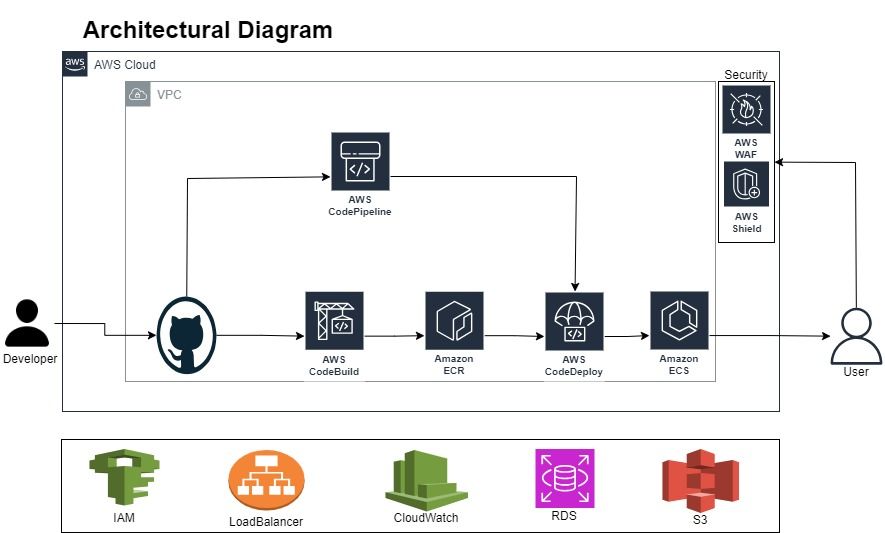
Implementation Process
The proposed solution had a transformative impact on Neerja Software Private Limited’s operations, resulting in:
-
Enhanced Scalability: The ECS Fargate-based architecture allowed applications to scale automatically based on traffic, eliminating downtime during peak usage.
-
Reduced Costs: By switching to a serverless model (Fargate), the client paid only for the resources consumed, significantly reducing operational expenses. Automation of deployments reduced manual labor and associated costs.
-
Improved Reliability: The use of ECS and RDS ensured high availability and fault tolerance, minimizing downtime and enhancing user experience.
-
Streamlined Deployments: Automated CI/CD pipelines ensured faster, error-free deployments, enabling quicker rollouts of new features and updates.
-
Strengthened Security: WAF, IAM roles, and VPC-based networking mitigated security risks, protecting sensitive application data.
Impact of the Solution
Enhanced Scalability:
- The ECS-based architecture ensured that the application could scale dynamically, handling peak traffic effortlessly.
- Average response times improved by 40% during high-demand periods.
Cost Optimization:
- By using AWS Fargate for serverless container management, the customer saved approximately 30% in operational costs by eliminating the need for managing and provisioning infrastructure manually.
Improved Deployment Efficiency:
- The CI/CD pipeline reduced the deployment time from hours to minutes, significantly accelerating feature rollouts and reducing downtime.
Higher User Satisfaction:
- Faster media uploads, image resizing, and AI-driven captions increased user engagement and satisfaction.
- User retention improved by 25% within the first three months of migration to ECS.
Robust Security:
- The integration of Secrets Manager and secure VPC settings addressed key security concerns, ensuring user data protection.
Global Availability:
- The load balancer and ECS ensured low-latency access for users globally, improving the application's reach and performance.
Return on Investment (ROI)
Cost Savings:
- Reduced infrastructure maintenance costs by 30% compared to on-premises systems.
- Optimized resource utilization through auto-scaling, reducing idle resource costs.
Increased Productivity:
- Automation of deployment reduced manual efforts by 50%, allowing the team to focus on innovation rather than maintenance.
Faster Time-to-Market:
- Deployment time reduced by 70% with CI/CD pipelines, enabling quicker delivery of application updates.
Improved User Experience:
- Enhanced application availability and responsiveness, resulting in a 25% increase in user satisfaction and retention.
Scalability for Growth:
- The new architecture provided the scalability to handle a 40% increase in traffic without additional investments in infrastructure.
Conclusion
Habilelabs successfully transformed Neerja Software Private Limited's legacy infrastructure into a modern, scalable, and cost-effective cloud-based architecture using Amazon ECS with Fargate. The solution not only addressed the client’s immediate challenges but also positioned them for future growth, delivering significant ROI and business value.


