
Case study · Financial services · AWS
Neerja Software Automated Its AWS Migration with Three CloudFormation Stacks
Neerja Software Private Limited runs a Laravel application and MySQL database that handles document verification for banks, making loan processing faster and more accurate for financial institutions and loan providers.
HabileLabs migrated it from an on-premises environment to AWS, using AWS CloudFormation to provision the infrastructure automatically.
- 35% lower operational costs
- 70% faster deployment cycles
- 40% higher developer productivity
Results at a glance
35%
Lower operational costs, with on-premises hardware and manual management removed
70%
Faster deployment cycles: releases take minutes instead of hours
50%
Improved scalability, with ECS Fargate auto-scaling absorbing traffic surges
40%
Higher developer productivity, with infrastructure work automated
The Challenge
Neerja Software's on-premises infrastructure caused several problems. The company needed fully automated, scalable and standardized AWS infrastructure to simplify deployment and scaling.
Complex infrastructure management
The infrastructure was difficult to manage, which increased operational overhead and maintenance costs.
Manual deployments
Manual processes caused frequent deployment errors, delayed updates and left development and production environments inconsistent.
Limited scalability
The setup could not scale with traffic spikes, which led to downtime and performance issues.
No standardization
Without an Infrastructure as Code (IaC) approach, environments were hard to replicate and scale.
Security and compliance gaps
The infrastructure lacked network isolation, IAM role-based access control and automated security group configuration.
The Solution
HabileLabs proposed a CloudFormation-based Infrastructure as Code (IaC) solution to make deployment fully automated and standardized. It used three CloudFormation templates.
Network
Provisions the VPC, public and private subnets, route tables and security groups.
Containers
Sets up the Amazon ECS cluster on AWS Fargate, with task definitions, auto-scaling policies and service configurations for the containerized workloads.
Deployment pipeline
Sets up AWS CodePipeline with AWS CodeBuild and AWS CodeDeploy stages, so applications deploy directly from the source repository without manual steps.
This approach removed manual effort, improved security and kept environments consistent, improving deployment efficiency and operational scalability.
Solution Architecture
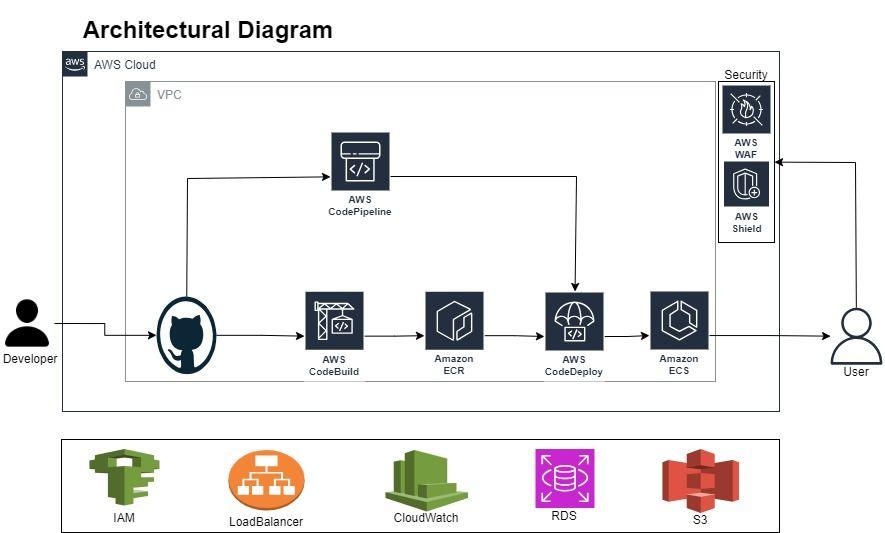
Infrastructure Setup with CloudFormation
CloudFormation templates automate the provisioning of AWS resources, so every environment is consistent and repeatable. Three separate stacks were implemented.
Serverless VPC Setup Stack
Created a dedicated VPC with two public subnets and an Internet Gateway for public access. Route tables and security groups control networking, and an Application Load Balancer (ALB) distributes traffic.
Serverless Container Setup Stack
An Amazon ECS cluster runs the containerized Laravel applications as AWS Fargate tasks, with task definitions for Greenfinch-Legal, Greenfinch and Greenfinch-Banker. Auto-scaling adjusts running containers to traffic, and the ALB target group routes requests.
CodePipeline Build & Deploy Stack
AWS CodePipeline automates CI/CD. AWS CodeBuild fetches source code, builds Docker images and pushes them to Amazon ECR, Git Sync with Bitbucket pulls the latest code, and AWS CodeDeploy deploys to the ECS services.
How CloudFormation Helped
Infrastructure as Code (IaC)
CloudFormation templates automated the creation and deployment of the entire infrastructure, keeping environments consistent.
Modular, Reusable Stack Design
Three stacks separate networking, application deployment and CI/CD, which makes each easier to maintain.
Automation with Zero Manual Effort
Infrastructure provisioning and updates are fully automated, removing manual errors and reducing deployment time.
Security and Compliance
IAM roles and security groups are enforced programmatically. AWS WAF, deployed through CloudFormation, protects against threats such as SQL injection and XSS.
Scalability and Reliability
Auto-scaling policies scale ECS tasks with demand, improving availability and performance.
Faster CI/CD with Git Integration
AWS CodeStar Connections links Bitbucket to the pipeline, so builds and deployments run without manual intervention.
Business Impact
The CloudFormation-driven migration to AWS delivered measurable benefits for Neerja Software Private Limited.
35%
Reduced Operational Costs
Removed on-premises infrastructure costs, including hardware maintenance and manual management. Pay-as-you-go pricing for AWS resources optimized cloud spending.
70%
Faster Deployment Cycles
The automated CI/CD pipeline cut deployment time from hours to minutes, and removing manual deployment errors improved system stability.
50%
Improved Scalability
ECS Fargate auto-scaling handled traffic surges, so the client can support more users without additional infrastructure investment.
40%
Increased Developer Productivity
CloudFormation and CodePipeline automation freed developers from infrastructure work to focus on features.
Stronger Security and Compliance
Automated security configuration hardened the infrastructure. AWS WAF, IAM roles and VPC isolation improved data protection and regulatory compliance.
Conclusion
Planning something similar?
HabileLabs used AWS CloudFormation to automate infrastructure deployment for Neerja Software Private Limited. The move from on-premises to AWS, built on Amazon ECS with AWS Fargate, an Application Load Balancer, Amazon RDS for MySQL and AWS CodePipeline, gave it a scalable, cost-effective and secure environment.